What Is AI Marketing and How Teams Actually Use It
What is AI marketing, really? A practical guide to the core technologies, use cases, ROI metrics and ethical pitfalls, with advice on choosing scheduling tools.
AI marketing uses machine learning, natural language processing, computer vision, generative AI and automation to improve audience segmentation, personalisation, content creation and campaign optimisation. In the UK, approximately 15% of businesses had adopted at least one AI technology, while a further 2% were piloting AI and 10% planned future adoption. UK government research puts those figures at roughly 432,000, 62,000 and 292,000 businesses respectively.
You may recognise the problem even if you don't recognise the terminology. Leads sit in an overflowing inbox, campaign data accumulates faster than anyone can interpret it, and every channel demands another version of the same message. Then a new tool promises to write captions, find audiences, answer customers and optimise campaigns, often leaving you to work out whether it improves marketing or merely produces more activity.
Table of Contents
- A Working Definition of AI Marketing
- The Core Technologies Behind the Hype
- Where AI Fits Inside the Marketing Workflow
- Practical Use Cases and Real Examples
- Measuring AI Marketing With Honesty
- Ethics, Disclosure and Common Pitfalls
- Implementing AI Marketing in Your Team
- Choosing Tools That Actually Support AI Marketing
A Working Definition of AI Marketing
AI marketing is the application of artificial-intelligence systems to marketing decisions and execution. That includes machine learning for pattern detection, natural language processing for understanding and producing language, computer vision for interpreting images and video, generative AI for creating drafts, predictive analytics for forecasting outcomes, and automation for moving work through a process.
The activities are broad. AI can support audience segmentation, personalisation, content creation, customer engagement, lead generation, campaign optimisation and sales support. UK economic measurement identified 994 descriptions of domestically supplied AI services associated with customer engagement, sales, marketing and content, representing 17.0% of the service descriptions examined. The category covered chatbots, virtual assistants, CRM applications, sales intelligence, campaign optimisation and content creation. The Office for National Statistics shows why “AI marketing” is better understood as a collection of methods than as one software category.
The key distinction is that AI marketing isn't the same as AI-generated content. A tool that drafts a caption may help with one task, but it hasn't necessarily analysed customer behaviour, predicted an outcome, selected an action and learned from the result. A creator using an AI caption assistant, an agency producing drafts for several clients and an enterprise connecting AI to its CRM are all using AI differently.
Practical rule: Treat “AI” as a description of a workflow capability, not proof that a tool is intelligent, effective or suitable for your team.
Adoption figures also need careful reading. One UK government survey found 16% of businesses used at least one AI technology, with 5% planning to adopt one, while 80% of AI-using businesses used AI at least weekly. The UK AI Adoption Research report makes the practical lesson clear: recurring workflows matter more than occasional experiments.
For a broader introduction, this guide to AI marketing for businesses can provide additional context. The useful question for your own team is narrower: which marketing decision or repetitive task can AI improve, and how will you know?
The Core Technologies Behind the Hype
The technical stack becomes easier to understand when you give each layer a job.
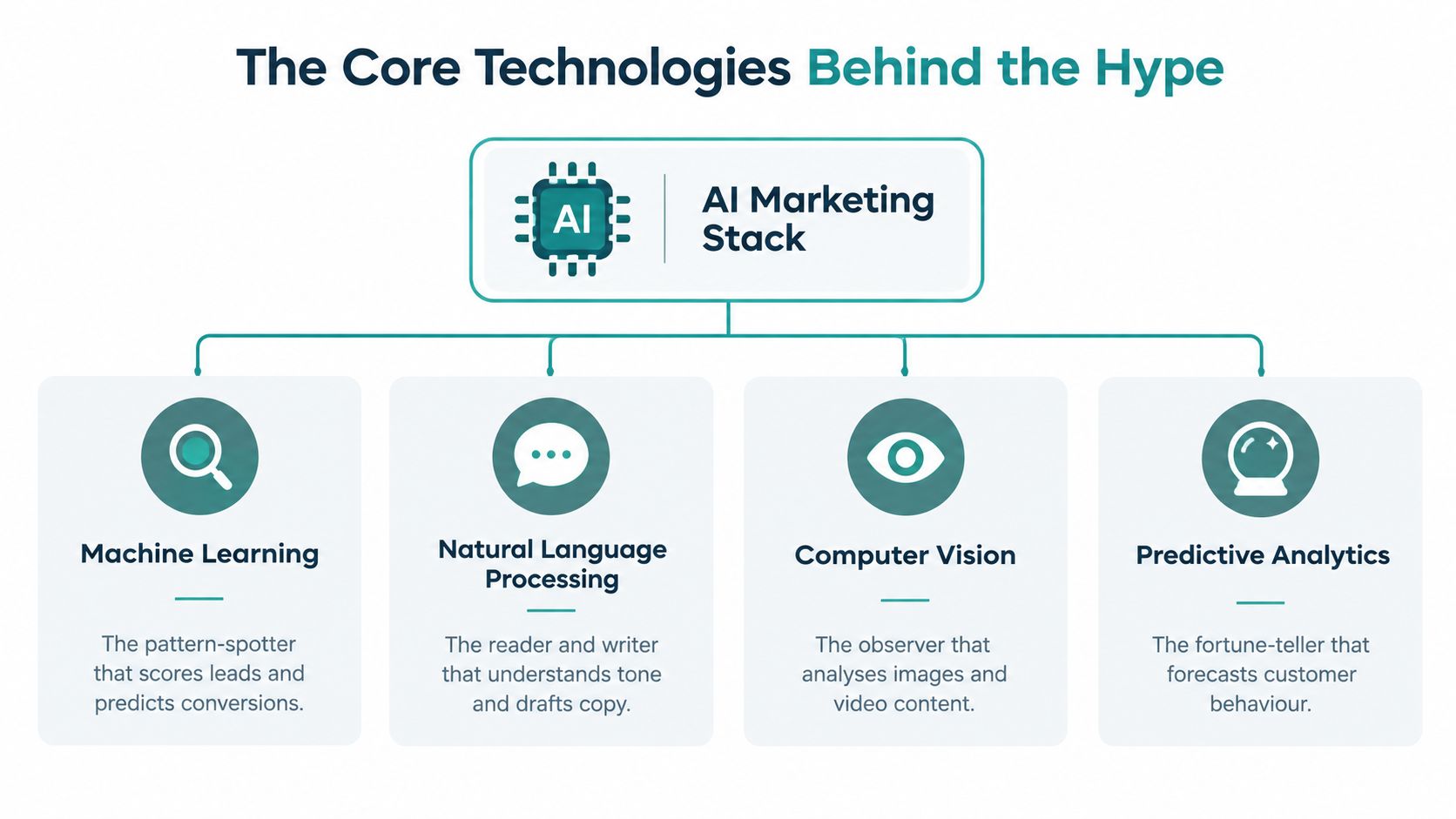
Machine learning is the pattern-spotter. Feed it suitable historical data and it can identify relationships that help a team score leads, estimate conversion probability or group customers by behaviour. It doesn't “understand” a customer in the human sense. It calculates a likelihood from patterns in the data it has been trained to use.
Natural language processing is the reader and writer. It can classify the sentiment in customer comments, summarise research, route support questions, power a chatbot or draft several versions of an advert. Its strength is handling language at scale. Its weakness is that fluent wording can conceal an incorrect claim, an unsuitable tone or a missing qualification.
Computer vision is the marketing team's eye. It can tag products in images, classify creative assets, identify objects in video or help screen user-generated content. That may support asset libraries and brand-safety checks, but visual systems can misclassify content, particularly when the training examples don't represent the situations they encounter.
Generative AI is the studio. It produces text, images, audio or video drafts from an instruction and some context. The output is a starting point, not an approved campaign. Human editors still need to check facts, rights, accessibility, tone and whether the material represents the brand.
Predictive analytics connects these capabilities to decisions. Automation then acts as the workflow plumbing, moving a scored lead into a CRM queue, adapting a message for a channel or triggering a review task.
The real operating model is a closed loop: first-party data enters the system, a model estimates an outcome, the team or system selects an action, results are measured, and the model or workflow is tested again.
That loop separates substantive AI marketing from a standalone writing assistant. UK regulatory guidance on AI principles also makes clear that the loop needs controls around data minimisation, security, fairness and explainability. Without reliable inputs, accountable decisions and feedback, “AI” is often just a label attached to ordinary automation.
Where AI Fits Inside the Marketing Workflow
Consider a small direct-to-consumer brand launching a new product across Instagram, TikTok, email and paid media. AI can appear at every stage, but each use has a different risk and a different owner.
At the research stage, natural language processing can group recurring themes from reviews and support conversations. Machine learning can help segment customers by recent behaviour or estimate which leads are more likely to buy. The team should still decide whether those segments make commercial and ethical sense. A model can find a pattern, but it can't determine whether the pattern reflects a useful preference or an unfair proxy.
During planning, a marketer might ask a generative tool for campaign angles, subject-line variations or platform-specific adaptations. That accelerates exploration, but the human team should define the proposition, audience promise and brand voice first. Strategy is a poor first candidate for full automation because it involves trade-offs, positioning and knowledge that may not exist in the input data.
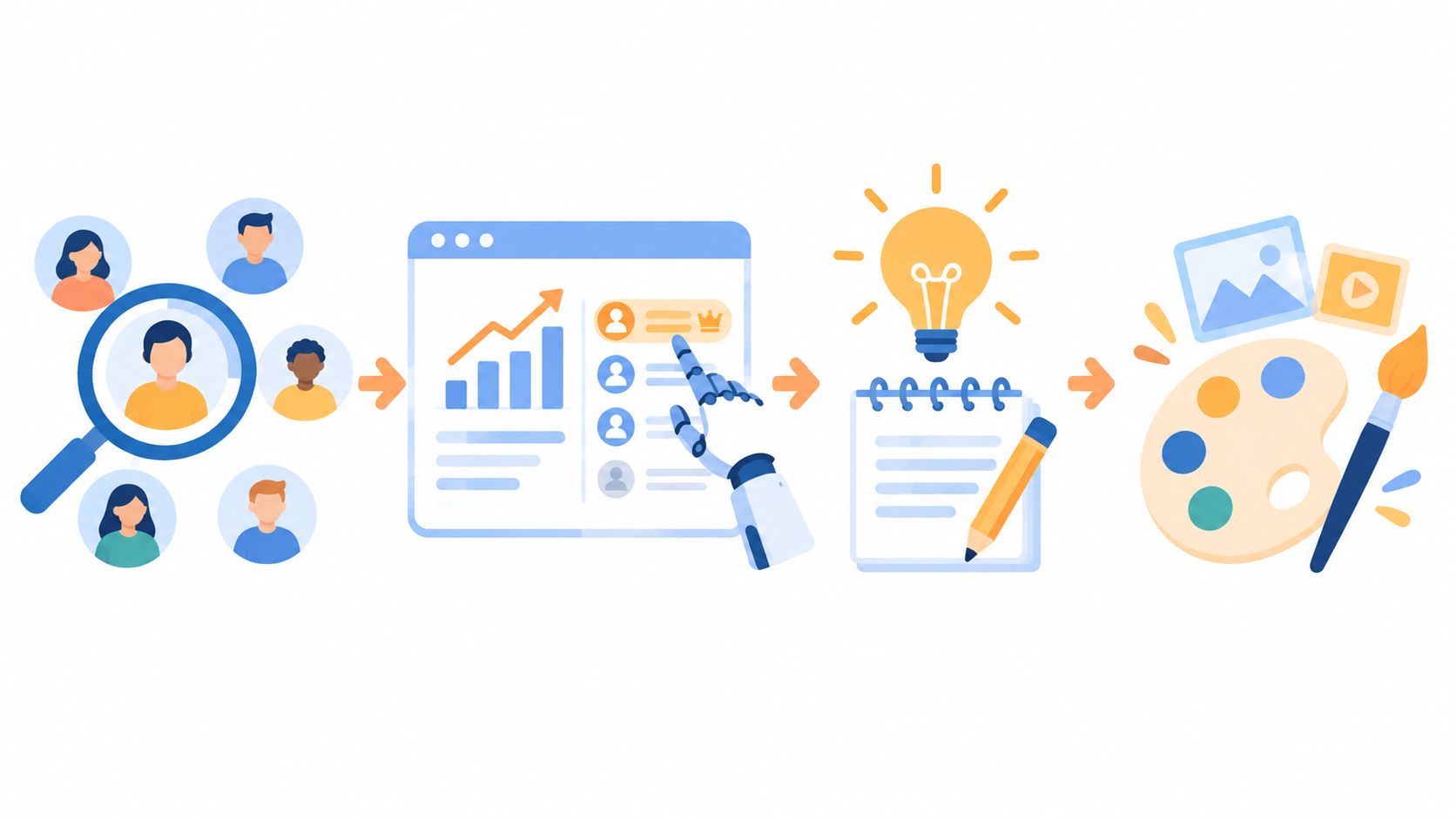
Content creation is more suitable for a controlled pilot. A team can generate several caption structures, turn one product explanation into platform-specific drafts and flag missing information for an editor. Computer vision may help organise the associated images, while a scheduling platform can prepare approved variations for distribution. The tool doesn't replace the approval decision.
A useful workflow looks like this:
- Research: Collect consented, relevant first-party signals from purchases, site behaviour, support interactions or campaign responses.
- Decide: Use models for segmentation, lead scoring or likely response, then review the logic and exclusions.
- Create: Generate drafts and variations within a documented brief.
- Approve: Check facts, claims, rights, accessibility, brand voice and disclosure requirements.
- Distribute: Adapt approved content to each platform and monitor delivery.
- Learn: Compare outcomes with the baseline and revise the workflow.
Teams looking for practical startup applications can also consult AI marketing workflows for startups, particularly when deciding which repetitive process to pilot first. Start with lead scoring, copy variation or reporting. Leave crisis response, final positioning and sensitive customer decisions under experienced human control.
Practical Use Cases and Real Examples
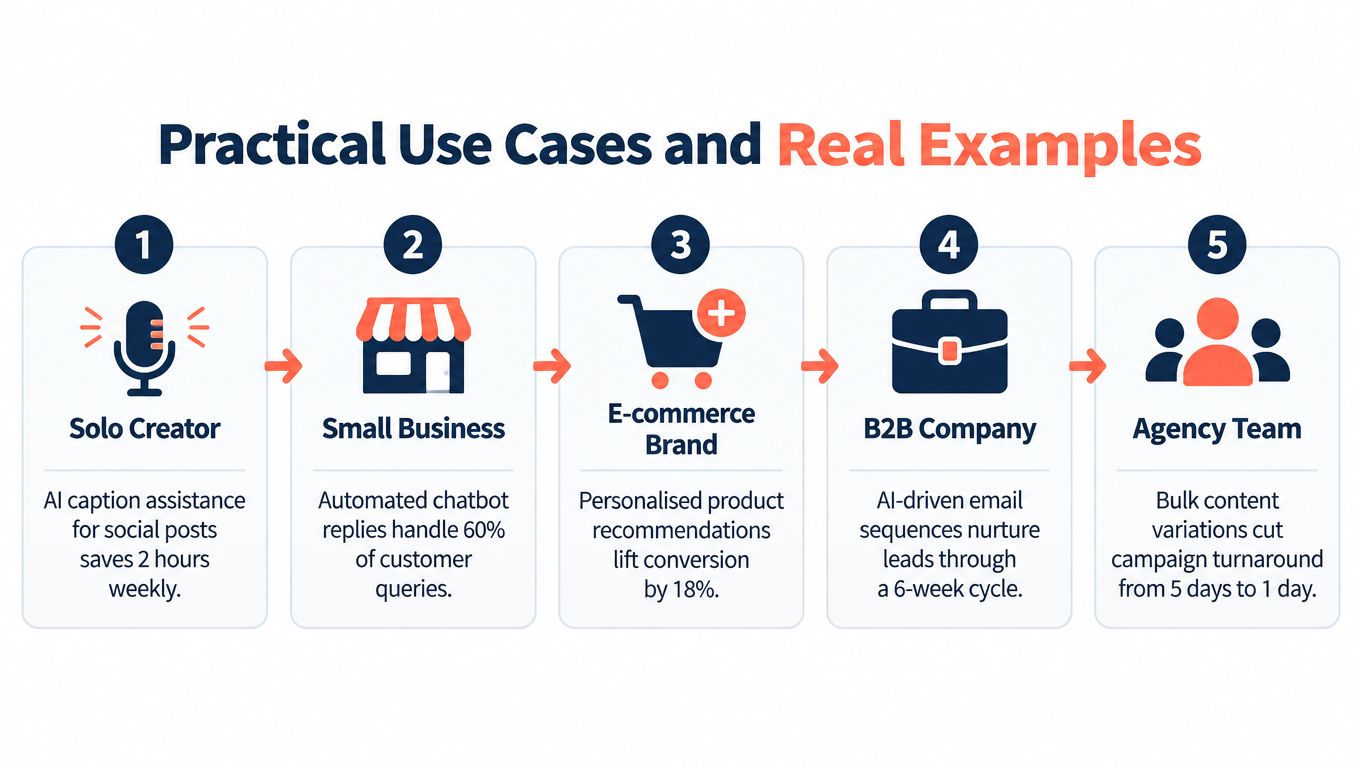
The phrase “AI marketing” means something different at each operating scale. A solo creator may use it as an editorial assistant, while an enterprise may connect predictive models to a customer database. Comparing the workflows prevents a small team from buying a complex platform for a problem a simpler tool could solve.
Solo creator
A creator can use an AI writing assistant to turn a transcript, idea or long-form article into caption drafts. The output is a set of options that still needs personal editing, fact-checking and a voice check. A sensible measure is time from idea to approved post, not the number of captions produced.
Small business
A small retailer may deploy a chatbot or automated reply system for routine questions about opening hours, delivery or product details. The system should route unusual, sensitive or dissatisfied customers to a person. Track unresolved conversations, correction frequency and customer satisfaction rather than assuming that more automated replies equal better service.
Agency team
An agency managing several clients can use generative AI to create first drafts from approved briefs, then apply a structured review process for each account. The benefit is consistency during production, not permission to remove account expertise. Measure review time, correction rate and the number of client revisions.
Enterprise CRM
A larger organisation may integrate AI scoring into its CRM to prioritise leads or identify likely churn. This requires stronger documentation, access controls and monitoring because the model influences sales attention and potentially customer treatment. The team should examine false positives, false negatives, fairness and whether salespeople can challenge a score.
DTC brand
An online retailer might use behavioural data to personalise product recommendations or email content. The commercial question is whether the recommendation improves the customer's experience and business outcomes without becoming intrusive. Review consent, data minimisation, exclusion rules and conversion quality together.
The common thread is limited scope. A tool promising one-stop automation usually handles only a slice of the work, whether that's drafting, prediction, classification or distribution. The team still supplies the objective, the context, the approval and the accountability.
Measuring AI Marketing With Honesty
Measurement separates a useful experiment from an impressive demo. Start by describing the workflow in plain language, such as “turn a product brief into an approved social post”, then record how the work happens today.
Use both leading indicators and lagging indicators. Leading indicators show whether the process is becoming easier or safer. Lagging indicators show whether the business or audience benefits.
| Measure | What it tells you |
|---|---|
| Time saved per approved post | Whether drafting and review require less effort |
| Correction rate on AI drafts | Whether the tool creates avoidable factual, tonal or compliance work |
| Review cycle length | Whether content reaches approval more smoothly |
| Conversion rate | Whether the campaign produces a stronger response |
| Engagement quality | Whether people take meaningful actions, rather than merely generating impressions |
| Brand-safety incidents | Whether automation introduces unacceptable risk |
| Incremental revenue | Whether the activity creates value beyond the existing baseline |
Don't confuse adoption with impact. A marketing-sector survey cited in UK-focused reporting described 80% adoption among UK marketers, while other UK evidence reported 16% of businesses using AI and ONS data for businesses with ten or more employees reported 21%. The analysis of UK adoption differences explains that these figures use different populations, respondents and definitions. They aren't interchangeable.
A disciplined pilot can follow five steps:
- Define the workflow: Specify the input, output, human checkpoints and intended outcome.
- Baseline the work: Record current time, corrections, review stages and business results.
- Run a limited pilot: Keep the use case narrow enough to inspect.
- Compare fairly: Use the same success measures and account for seasonality or campaign differences.
- Decide deliberately: Embed, iterate or drop the workflow.
High tool usage is a workflow indicator, not evidence of marketing effectiveness.
The strongest result may be a safer process, faster approvals or better prioritisation rather than a larger content library. If the pilot produces more drafts but also more corrections, it hasn't created a clear gain.
Ethics, Disclosure and Common Pitfalls
A scheduling tool can produce a week of polished posts in minutes, yet the same workflow may publish an inaccurate claim or target people unfairly. AI marketing becomes risky when speed replaces evidence, human judgement and clear accountability. A closed optimisation loop should therefore include checks on its data, outputs and publishing decisions, not just performance feedback.
Biased training data can reinforce stereotypes in segmentation or personalisation. Review the variables used, record why they matter and test outcomes across meaningful groups. Opaque targeting can make people feel watched or unfairly excluded. Explain the purpose of personalisation, minimise the data collected and avoid attributes that act as problematic proxies.
Fabricated claims create a direct publishing risk. Generative systems can produce confident wording without reliable evidence, so a person must verify product specifications, testimonials, comparisons, health statements and performance promises before publication. Filta's take on AI claim risks helps teams examine how persuasive language can outrun substantiation.
Disclosure requires judgement rather than a universal label. Kantar's 2025 UK Media Reactions findings reported that 55% of consumers felt positive about generative AI generally, but only 38% were excited about its use in advertising; 61% worried about fake ads. UK-focused reporting also cited YouGov research in which 86% of Britons considered AI-use disclosure important, while only 25% believed they could recognise AI-generated content. The responsible AI marketing discussion explains why audience trust may matter more than production speed. Teams choosing a scheduler should ask whether an AI label clarifies a material fact or merely draws attention to an invisible technical process.
The ASA says there is currently no blanket UK legal requirement to disclose every use of AI in an advertisement, and the CAP and BCAP Codes contain no AI-specific disclosure rule. Disclosure becomes particularly important when AI is prominent but not obvious, such as a synthetic influencer, voice or deepfake. Existing rules still apply to claims and targeting regardless of how an advert was created. Influencer content also needs clear commercial disclosure when an incentive or brand connection exists, with an upfront label such as “Ad” where the relationship is not already clear. See the ASA guidance on AI in advertising and its influencer advertising guidance.
UK GDPR adds another boundary. Article 22 restricts solely automated decisions with legal or similarly significant effects, subject to limited exceptions and safeguards such as human intervention, an opportunity to express a view and the ability to contest the decision. Ordinary advert delivery will usually fall outside that restriction, but high-impact profiling and exclusion require closer review. For social direct messages, the ICO states that a message containing an affiliate link counts as electronic mail under PECR, so unsolicited messages will usually require consent and an opt-out route. The ICO's advice on social-media direct marketing applies whether an algorithm wrote the message or not.
For publishing checks, teams can use this AI social media content generator guidance alongside their approval policy. Label content where leaving it unlabeled could mislead, and retain human review for claims, sensitive audiences and decisions with meaningful consequences.
Implementing AI Marketing in Your Team
A controlled rollout avoids the common mistake of buying tools before defining the work.
Audit before selecting
Map the existing process from data input to final publication. Look for repetitive tasks that already have a measurable outcome, such as lead triage, reporting, content variation or support routing. Note where errors occur, who approves the result and which systems contain personal information.
Pilot a narrow use case
Choose one or two workflows with clear baselines. A useful pilot might generate draft social posts from an approved brief, classify incoming enquiries or summarise campaign performance. Don't begin with full automation of strategy, brand voice or crisis communication. Those jobs depend heavily on context and judgement.
Embed what survives review
If the pilot performs well, add it to a recurring process with named owners. Document the prompt or model settings, data sources, review criteria, escalation route and approval record. A workflow isn't embedded until another trained team member can understand how it works and challenge its output.
Govern the programme
Review access permissions, retention, security, fairness and vendor terms. Keep final brand-voice review, factual claims, rights clearance for synthetic media and sensitive customer decisions with people who are accountable for the result. Re-evaluate the workflow when the model, data source, platform or campaign objective changes.
Before signing a contract, ask the vendor:
- Data use: Will customer inputs be used for training, and how can the team control retention?
- Traceability: Can users see which data, instructions or rules influenced an output?
- Human control: Can staff review, edit, reject and override recommendations?
- Rights: Who is responsible for permissions, generated assets and disputed content?
- Security: What access controls, audit records and deletion options are available?
- Integration: Does the tool fit the CRM, analytics, approval and publishing systems already in use?
- Measurement: Can the team export the data needed to compare performance with its baseline?
A phased approach gives the team room to learn without making an irreversible promise. Guidance on the role of an AI marketing agent can help teams think through automation boundaries, but the same principle remains: define the job and the controls before delegating it.
Choosing Tools That Actually Support AI Marketing
Tool choice should follow the workflow, not the other way around. Teams are comparing three broad categories.
Analytics and personalisation platforms process customer or campaign data, identify patterns and support recommendations. They suit organisations with reliable first-party data and a clear decision to improve. They can be excessive for a small team that hasn't yet defined its baseline.
Creative and copy assistants generate drafts, variations, summaries or visual concepts. They are accessible and useful for exploration, but they need fact-checking, rights review and brand-voice approval. Their output may save production time without proving that the campaign will perform better.
Social media schedulers form the operational layer between approved content and channel distribution. They may support content adaptation, approvals, analytics or AI-assisted drafting, but capabilities vary. A scheduler isn't automatically a complete AI marketing system, because it may not own the customer data, prediction layer or measurement model.
For teams comparing scheduling software, real tools in the market include Buffer, Hootsuite, Later, Sprout Social, SocialBee, Metricool, Publer, Vista Social, Planable, Postiz and Typefully, among others. Each has different strengths and limitations around supported platforms, collaboration, analytics, drafting and approval workflows. Features and pricing can change, so check the vendor's current information before making a decision.
Scheduler.social is an independent directory that reviews and compares social media scheduling tools. You can use its head-to-head comparisons, platform-specific recommendations and use-case pages for agencies, solo creators, approval workflows and AI writing to narrow the shortlist. The directory isn't a scheduling tool and doesn't publish posts itself. It helps you compare products that may become part of the workflow you have already defined.
The final test is simple. Does the tool reduce a measured bottleneck while preserving review, accountability and useful data? If the demo looks impressive but the process creates more corrections, unclear ownership or unmeasurable outputs, choose a quieter tool or postpone the purchase. More automation isn't the objective. A dependable closed loop, from first-party data to reviewed action and measured learning, is.
For further comparison criteria, this overview of AI marketing tools can help you assess where creative assistants, analytics platforms and schedulers fit together.
Scheduler.social is an independent directory for comparing social media schedulers, with tool profiles, head-to-head comparisons, platform guides and use-case filters. Visit Scheduler.social to compare options such as Buffer, Hootsuite, Later, Sprout Social and others, then find the scheduler that fits your team, approval process and AI-assisted workflow.