Evergreen Content Strategy: A Practical Framework
Build a repeatable evergreen content strategy with our practical framework, real examples, and workflow tips for social teams. Compare schedulers

Most evergreen content advice is wrong in one important way. It treats publication as the finish line, then promises that a well-written page will keep working indefinitely. It won't. Search behaviour changes, products change, links decay, and readers become less willing to click when an answer engine can summarise the basics before they reach your page.
An effective evergreen content strategy is a maintenance and resource-allocation system. You choose durable problems, create assets that answer them clearly, distribute those assets repeatedly, and spend editorial time where the evidence shows continued value. The return comes from disciplined upkeep, not from labelling an article “ultimate” and forgetting it exists.
Table of Contents
- Why Evergreen Content Is a Maintenance Job, Not a Publishing Win
- What an Evergreen Content Strategy Actually Is
- The Real Benefits and the Metrics That Prove Them
- The Five-Stage Evergreen Workflow
- Matching the Workflow to Your Team Size and Tools
- Three Evergreen Assets in Practice
- When to Refresh, Narrow, Redirect or Retire an Evergreen Asset
- Your 30-Day Evergreen Starter Plan and Next Step
Why Evergreen Content Is a Maintenance Job, Not a Publishing Win
Evergreen content earns its name through continued usefulness, while its supporting facts, tools and formats keep changing. A guide to choosing social media scheduling software may retain its core intent, yet supported networks, approval features, pricing models and platform policies can shift underneath it. Treating publication as the finish line turns a durable asset into a gradual liability.
UK search still gives durable resources a substantial audience. In May 2024, 47.4 million UK adults used the internet through smartphones, tablets or computers, spending an average of 4 hours and 20 minutes online each day. During the same month, 90% of UK online adults visited at least one of the ten highest-reaching search engines, while Google reached 83%, approximately 39.6 million people (Ofcom's Online Nation 2024 report).
That reach supports investment in explainers, comparisons, definitions and how-to guides. It also creates an upkeep obligation. Google's reach declined from 86% in May 2023 to 83% in May 2024, a three-percentage-point year-on-year change, while search remained a near-universal route to information. Your content must serve stable user needs as products, regulations, prices and search formats change.
The quiet decay problem
An old URL can look successful after accumulating links and rankings. Those signals do not prove that the page still deserves its position. Obsolete screenshots, an outdated tool list or unclear commercial disclosures can damage trust even when impressions remain healthy.
Search is becoming more answer-led. Ofcom-reported evidence puts Google's UK reach at about 82% of adults and roughly 3 billion UK searches per month, while other reporting of the same research says around 30% of searches display an AI Overview and 53% of UK adults frequently see AI summaries (UK SEO statistics reported by Whito). Durable pages now need concise answer blocks, explicit entities, clear headings and evidence that answer systems can interpret accurately.
Practical rule: Give every evergreen page a review date, an owner and a documented reason to remain live.
Allocate the programme accordingly. Audit before creating, schedule distribution, repurpose proven material, and measure whether maintenance still earns its place in the editorial queue. Publishing starts the operating cycle. It does not complete it.
What an Evergreen Content Strategy Actually Is
An evergreen content strategy is a planned system for creating, distributing and maintaining content that answers a recurring need. It differs from trend content, which depends on current attention, and seasonal campaigns, which depend on a calendar moment. It also differs from a pillar page. A pillar page is a broad organising asset, but it may contain volatile claims and still require regular maintenance.
Use this internal test:
Would a stranger searching for this problem still find the page useful in twelve months?
If the answer is yes, the topic may be evergreen. If the page only works because a launch, controversy or event is happening now, treat it as timely content and give it a different production and retirement plan.
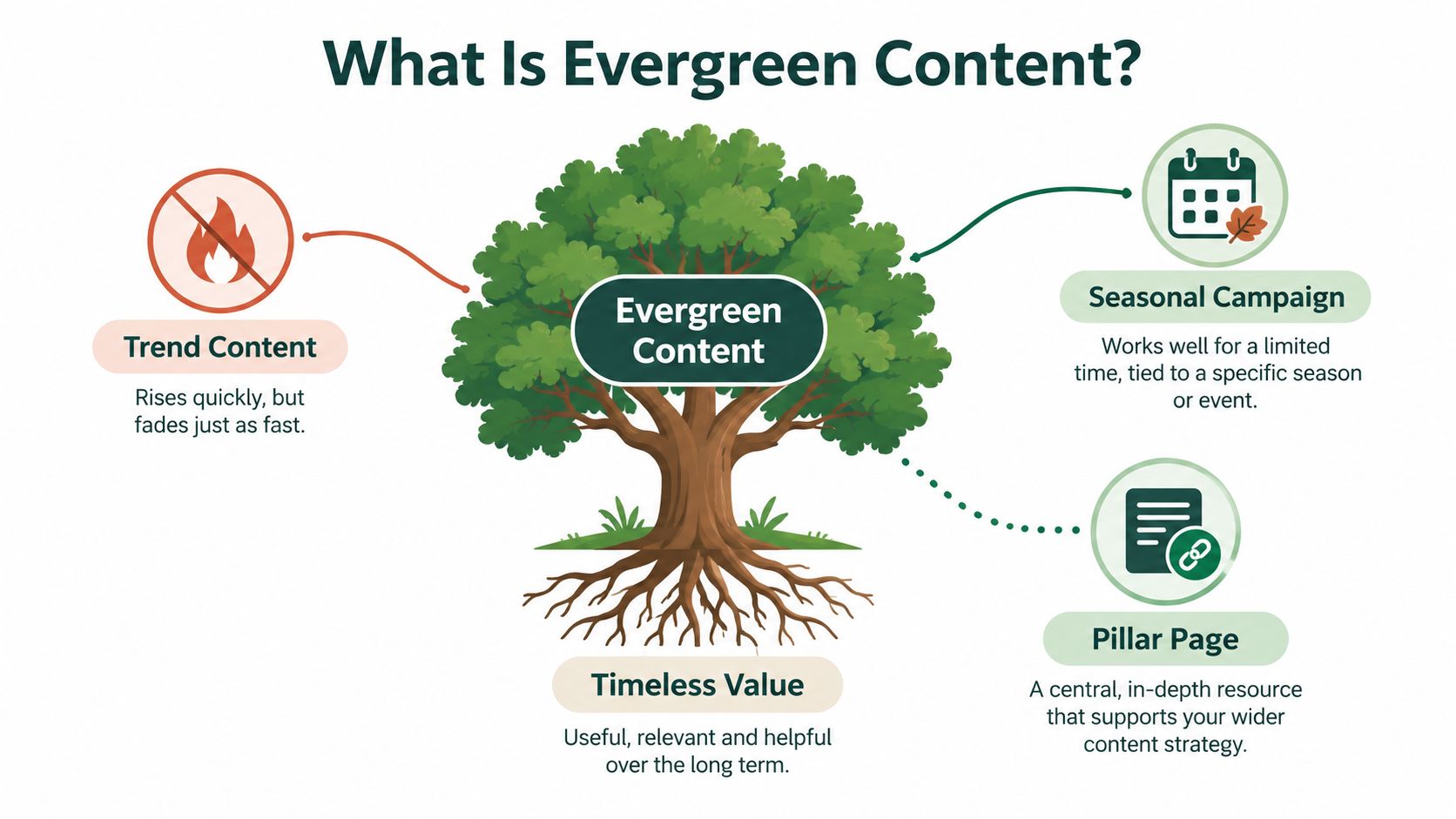
Two tests separate durable topics from false positives
First, assess search-demand stability. Recurring problems, such as how to create an approval workflow or how to compare schedulers for Instagram, are stronger candidates than a temporary product announcement.
Second, assess editorial update cost. A definition may need occasional wording checks. A tool comparison may require repeated verification of supported platforms, limits, pricing and policy changes. Both can be evergreen, but they need different maintenance budgets.
That distinction matters because evergreen content isn't automatically cheap. A page with stable demand and high update cost can still earn its place, but only if its conversions, assisted journeys or strategic importance justify the work.
Common asset types
For a social team, durable assets usually include:
- How-to guides: Explain a repeatable process, such as building a content approval workflow.
- Comparison pages: Help readers evaluate tools against stable criteria, while separating volatile evidence into updateable blocks.
- Definitions and FAQs: Answer foundational questions clearly and support internal linking.
- Templates: Give readers something reusable, such as a weekly content planning worksheet.
- Platform and use-case pages: Match recurring needs to tools, such as schedulers for agencies or solo creators.
A useful guide to the wider discipline is what content strategy involves. For a directory publisher, the practical question isn't whether every page can last forever. It's whether each page has a durable job, an accountable owner and a rational maintenance cost.
The Real Benefits and the Metrics That Prove Them
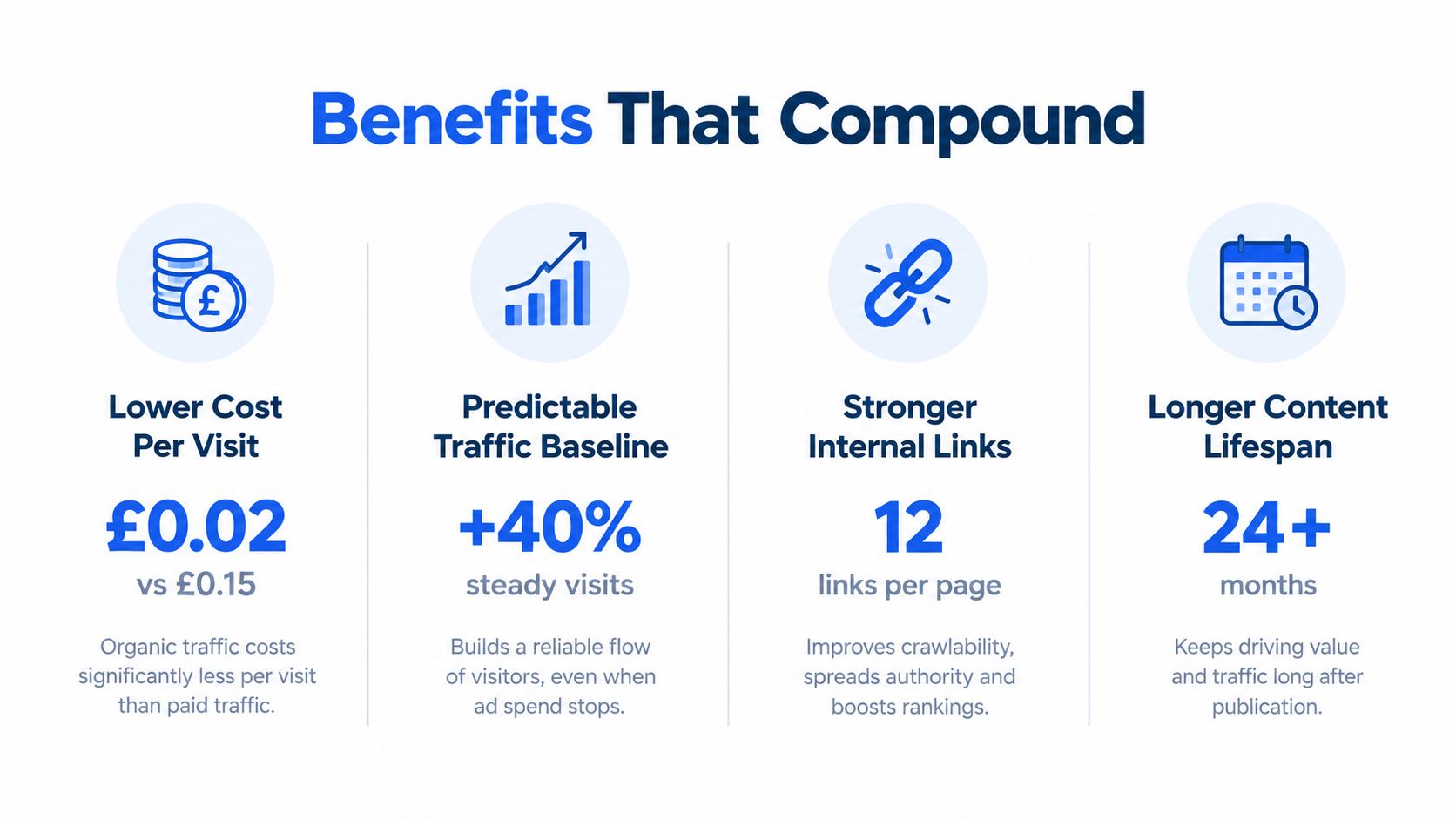
Evergreen content earns attention because it can reduce the marginal cost of future visits. Once a strong page exists, a new visitor can discover it through search, internal links, email or a repurposed social post without requiring a completely new article for every campaign.
The value usually appears in four places:
- A steadier visibility baseline: Durable pages can attract research traffic after the launch campaign ends.
- Lower production pressure: One well-maintained guide gives a team a reliable source for social posts, sales enablement and email content.
- Stronger internal linking: A useful page can connect related definitions, comparisons and use cases into a clearer journey.
- Better decision support: A transparent comparison can help readers move from a broad problem to a shortlist.
UK behaviour supports the investment. Ofcom recorded 19% of UK online adults saying they had used many websites they hadn't used before in 2023, up from 16% in 2022 (Ofcom's Adults' Media Use and Attitudes Report 2024). Evergreen resources can introduce new audiences to a specialist publisher, but only if those pages communicate authority quickly and remain transparent.
Measure the asset, not just the visit
Pageviews are a weak standalone success measure. A finance director needs to know whether the content attracts the right audience, supports commercial journeys and keeps producing useful outcomes after publication.
Track:
- Non-brand organic impressions: Are people discovering the page for the problem, not just the publisher name?
- Non-brand clicks and click-through rate: Is the result earning attention in changing search layouts?
- Assisted conversions: Does the page appear before a lead, enquiry or tool visit even when it isn't the last touch?
- Affiliate outbound-click rate: For commercial comparisons, do readers continue to a relevant tool site?
- Engagement by audience status: Compare first-time and returning users to see whether the page serves discovery and follow-up research.
- Refresh impact: Record what changed, when it changed and how impressions, clicks and conversions respond afterwards.
The useful question isn't “How many people visited?” It's “What valuable decision did this page help someone make?”
Build a simple reporting view that combines visibility, engagement and commercial assistance. For a broader way to think about return on content investment, PostSyncer's guide to content ROI provides useful context. The principle remains straightforward: protect assets that produce qualified outcomes, not pages that merely accumulate sessions.
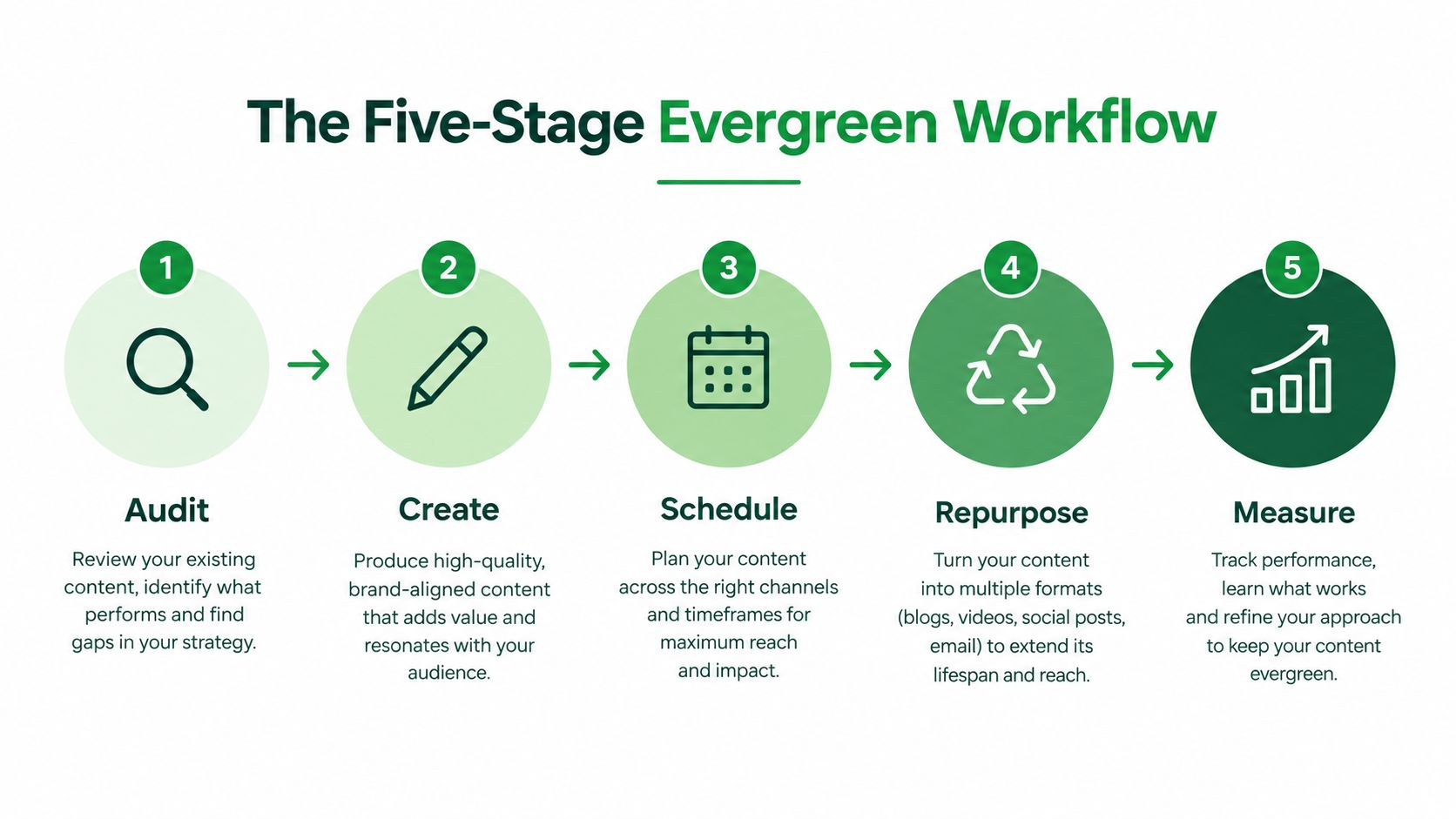
The Five-Stage Evergreen Workflow
A durable programme needs a hand-off between stages. Each stage produces something the next person can use, which prevents content work from becoming a series of disconnected publishing tasks.
1. Audit
Start with existing assets, not a fresh list of ideas. Put each page into a scoring sheet with fields for:
- Intent: What question or decision does the page serve?
- Demand: Are impressions and relevant queries stable, rising or falling?
- Accuracy risk: Which claims involve products, prices, platforms, policy or law?
- Commercial role: Does the page support an enquiry, comparison or assisted conversion?
- Maintenance cost: How much time does a proper review require?
The output is a decision: refresh, merge, narrow, redirect, archive or retain. Age alone isn't a reason to preserve a page.
2. Create
Build around a durable user job, then organise the topic into a pillar and supporting pages where the intents differ. Maintain a claim ledger for volatile facts, recording the source URL, observation date, geography, confidence and next review date.
Write for people and answer engines. Put a concise result near the top, label subtopics clearly, define important entities, include original comparisons and explain evaluation criteria. AI-assisted queries can be materially longer, about 23 words compared with roughly four words for traditional search in one industry synthesis of UK regulator data (SEO Works' UK SEO industry report). That makes edge cases valuable, but only when they represent distinct intents.
3. Schedule
Turn the published asset into a calendar entry, not a one-off announcement. Assign recurring social angles, platform owners, review status and approval responsibility. A comparison page might generate a criteria post, a short checklist and a question-led discussion, each adapted to the platform rather than copied mechanically.
Use content planning for social media to keep the calendar connected to the underlying editorial asset. The hand-off here is a set of approved source links and platform-specific post briefs.
4. Repurpose
Extract ideas from the asset without flattening every channel into the same message. A how-to guide can become a short mistake-led post, a visual checklist, an email explanation and a discussion prompt. Keep the original claim and link behind each variation so the team can verify context before publishing.
The goal isn't maximum volume. It's a sustainable stream of useful reminders that sends the right audience back to the durable resource.
5. Measure
Review organic visibility, qualified clicks, assisted conversions and outbound actions. Compare results against the asset's maintenance cost, then feed the decision into the next audit. A page with falling visibility but strong conversion quality may deserve a structural refresh. A high-traffic page with poor commercial relevance may need narrowing or a clearer next step.
Use this video as a practical prompt for reviewing how the stages fit together:
Matching the Workflow to Your Team Size and Tools
The same workflow looks different when one person owns every stage or an agency manages several client accounts. Don't copy an enterprise process onto a solo creator. Defend the stages that prevent expensive mistakes, then collapse the rest.
| Team profile | Stage to invest in most | Scheduler features that matter | Where to start comparing |
|---|---|---|---|
| Solo creator | Repurpose | Easy reuse, platform fit, manageable review steps | Solo-creator schedulers |
| Small business | Audit and measure | Clear calendar, reliable analytics, sensible collaboration | All scheduling tools |
| Agency | Schedule and approval | Client approvals, account separation, permissions and reporting | Agency schedulers |
Solo creators
A solo creator can combine audit and measurement in one monthly review. The protected stage is repurposing because one durable guide needs to produce enough platform-native material to justify the research effort. Buffer, Later, SocialBee, Metricool, Publer and Typefully may suit different publishing habits, but their strengths and trade-offs differ. Check current capabilities on each vendor's site before choosing.
Small businesses
A small business usually needs a straightforward calendar and dependable reporting more than a complex approval hierarchy. Hootsuite, Vista Social, Planable, Buffer and Metricool are examples worth comparing, but the right choice depends on supported networks, team roles, analytics depth and current pricing. Don't choose from a feature list alone. Map the tool to the workflow your marketer can realistically maintain.
Agencies
Agencies must defend approvals, account separation and client reporting. A fast publishing interface can't compensate for unclear ownership or an accidental post on the wrong account. Sprout Social, Hootsuite, Planable, Vista Social and other tools may fit different agency models, so compare permissions and review paths head to head rather than assuming the largest platform is appropriate.
Scheduler.social is an independent directory for comparing these kinds of tools, not a scheduling platform. Use its head-to-head comparisons to narrow the field, then verify current features and pricing with the vendor.
Three Evergreen Assets in Practice
A framework becomes useful when it changes what gets produced on Monday morning. These three examples use the same five stages but allocate effort differently.
A comparison page for small teams
Start with a stable question, such as how to choose social media scheduling software for a small team. Audit existing pages for overlapping intent, then define criteria including supported networks, approval workflows, analytics, account limits and pricing model. Publish the evaluation method before making individual recommendations. That makes editorial judgement visible and makes future updates more controlled.
Schedule posts that explain one criterion at a time. Repurpose the comparison into a shortlist prompt, a platform-specific question and a reminder to check current vendor information. Measure non-brand impressions, qualified tool clicks and assisted conversions. Hold back claims that cannot be verified, especially exact prices and fast-changing feature statements.
A how-to guide with original screenshots
A guide showing how to create a social approval process can remain useful if the underlying workflow is stable. Create the structure around roles, review states, hand-off rules and exception handling, then add screenshots only where they clarify a real action. Record the date and context for every interface image.
Repurpose the guide into a checklist and a common-mistakes post. Link related definitions and use cases through a controlled internal structure. A practical reference on smart repurposing workflows explained can help teams think beyond cutting one article into smaller paragraphs. Store source files, screenshots and review notes in an asset management system, so the next update doesn't begin with a scavenger hunt.

A recurring content calendar template
A weekly content calendar prompt is durable when it helps a reader make a repeatable decision, rather than promising a fixed list of ideas. Create the template around objectives, audience, platform, format, evidence and next action. Publish the blank version first, then add examples only where they clarify how to use it.
Schedule reminders that point back to the template, but vary the hook by platform. Measure downloads, return visits, assisted enquiries and reuse by subscribers. Retire prompts that generate activity without helping readers plan better.
When to Refresh, Narrow, Redirect or Retire an Evergreen Asset
The advice to “always update old content” wastes time. Some pages need new evidence. Others need a smaller scope, a redirect or a clean retirement.
Use a content half-life rule based on evidence, not URL age:
- Refresh in place when the intent remains clear, demand remains relevant and the page's claims can be revalidated.
- Narrow the page when one broad guide serves several incompatible intents. Split the questions and give each a focused destination.
- Redirect when an obsolete page's intent has merged into a stronger, current resource. Preserve useful authority rather than leaving two competing pages live.
- Archive or retire when demand has disappeared, evidence can't be verified, compliance risk is high or the page attracts the wrong audience.
Review declining impressions, falling click-through rate, search-result changes, outdated product claims, conversion quality and legal risk together. A page with stable rankings can still require urgent attention if its disclosures or recommendations no longer describe the current commercial relationship.
UK social content needs a recurring compliance check. The ASA says creators must disclose commercial relationships, including payment, gifts, free products and affiliate rewards, with a clear, prominent “Ad” label placed upfront (ASA influencer disclosure guidance). The disclosure needs to appear in each relevant piece of content, not only in a biography or separate post. Affiliate links and discount codes can make a post advertising, and commercial sections need clear identification (ASA disclosure cheat sheet).
Direct promotional messages require a separate check. ICO guidance says consent must be specific, informed, prominent, separate from privacy information and withdrawable, while unsolicited social-platform direct messages containing affiliate links can fall within electronic mail rules (ICO direct marketing guidance). Evergreen distribution is therefore an editorial governance task, not a licence to recycle indefinitely.
Your 30-Day Evergreen Starter Plan and Next Step
A useful first month should produce one maintained asset, not a crowded backlog.
Week one
Audit existing pages and choose one candidate. Record its intent, evidence, commercial role, update risk and owner in a claim ledger. Decide whether the page deserves a refresh, narrowing or retirement before commissioning new copy.
Week two
Create or rebuild one pillar asset for humans and answer engines. Put the direct answer near the top, use stable headings, define evaluation criteria, add evidence and link to genuinely distinct supporting pages. Avoid padding the article with questions that don't represent separate needs.
Week three
Run a repurposing sprint. Produce platform-native variations, assign approval owners and schedule the first distribution cycle. Choose a scheduling tool based on your actual team structure, network mix and review requirements, not on the longest feature list.
Week four
Measure initial visibility and engagement, check assisted actions, review outbound clicks where relevant and document what needs verification later. Add the asset to a maintenance queue with event-triggered checks for product, pricing, platform, policy or regulatory changes.
Keep this cadence after the first month:
- Weekly: Check scheduled distribution, broken links and obvious factual issues.
- Monthly: Review impressions, click-through rate, qualified actions and audience fit.
- Quarterly: Revalidate volatile claims, refresh internal links and reassess the asset's role.
- After major changes: Review platform support, pricing, policies, disclosures and screenshots immediately.
- At every annual planning cycle: Retire, merge or narrow assets that consume more resource than they return.
A strong evergreen content strategy doesn't maximise the number of old pages you keep alive. It concentrates effort on resources that remain useful, discoverable and commercially honest.
Scheduler.social is an independent directory where you can compare social media schedulers, review head-to-head options and filter tools by platform or use case. Visit Scheduler.social to find the right scheduling software for your team's evergreen publishing, repurposing and measurement workflow.