Audience Segmentation: How to Split a Social Audience
Audience segmentation for social media in 2026: methods, UK evidence, measurement, and how creators and agencies choose segments.
You've posted the same video to TikTok, Instagram and Facebook, changed only the caption length, and now you're staring at results that make no sense. One group saves it, another scrolls past, and a third comments asking a question you answered in the post. The problem isn't effort. It's that your follower total is hiding several different audiences who want different things from you.
Audience segmentation is how you stop treating that total as one person. Done well, it doesn't mean making five versions of everything. It means keeping only the splits that change what you publish.
Table of Contents
- What Audience Segmentation Actually Means
- Age and Channel Are Not the Same Segment
- Class Region and Access Change the Plan
- Choose Segments Within the Legal Limits
- How to Measure and Refresh Each Segment
- Social Examples for Creators Shops and Agencies
- Keep Two Segments and Compare Schedulers
What Audience Segmentation Actually Means
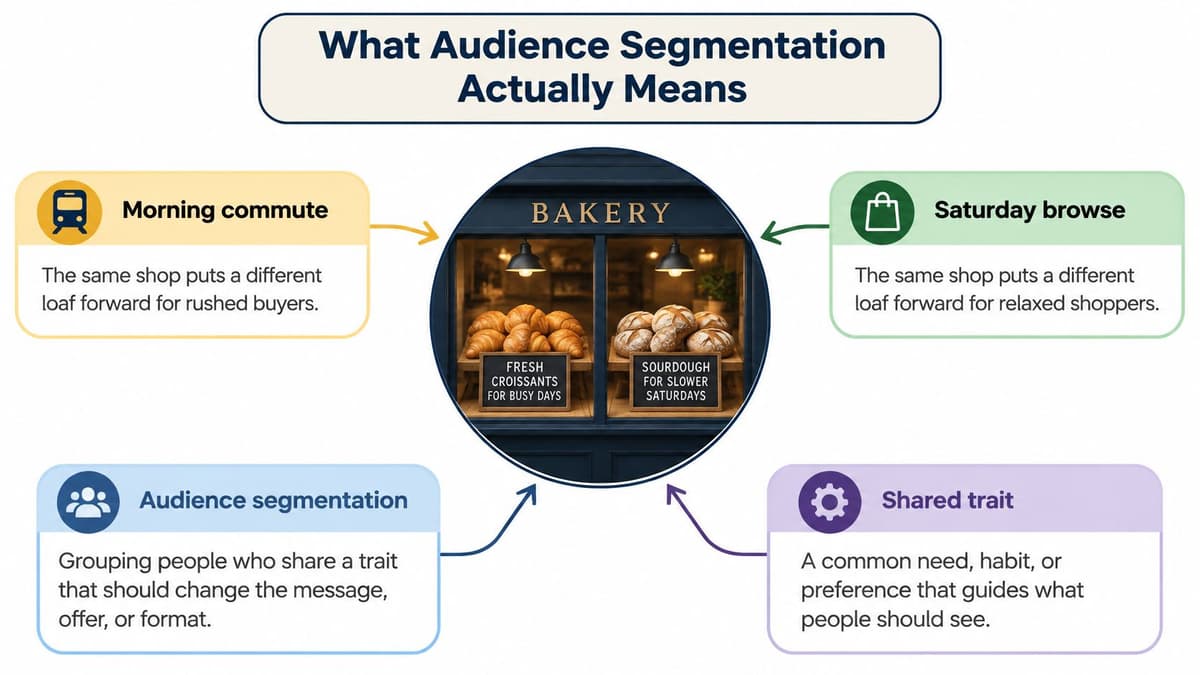
Say a bakery runs one shop on a busy street. On weekday mornings, commuters grab something quick without breaking stride, so the window puts a filled roll and a price board at eye level. On Saturday, browsers wander in with time to spare, so the same window leads with a whole loaf to take home and a sample to try. The shop hasn't changed. The group in front of it has, and the display changes with them.
That's audience segmentation in plain terms. You're grouping people who share a trait that should change the message, format, channel or offer, instead of posting one version to everyone and hoping it fits.
Why one follower total misleads you
A single account usually holds people at odds with each other. Some want a 15 second tip they can save and use today. Some are comparing prices and need proof before they spend. Some already buy from you and only want to know what's new. If you write for an average of those three, you write for nobody in particular, and each group has a reason to skip.
It matters more now because feeds reward quick relevance. A post that doesn't land in the first seconds gets skipped, and paid promotion gets expensive fast when the wrong group sees it. For a deeper look at gathering this kind of evidence before you commit, audience insights for social video creators walks through practical research methods you can adapt to your own accounts.
Practical rule: A segment earns its place only when it would make you publish something different. If the post stays the same, you have a label, not a segment.
Seven methods and what each one should change
Use the table as a filter, not a checklist. You don't need all seven. You need the one or two that would change your next post.
| Method | Groups people by | Changes this | Where it misleads |
|---|---|---|---|
| Demographic | Age, life stage, gender | References, reading level, examples | Same age does not mean same behaviour |
| Geographic | Nation, region, city, radius | Local proof, hours, language | A national campaign can hide regional gaps |
| Psychographic | Values, motives, interests | Hook and offer | Interest labels can be guessed, not observed |
| Behavioural | Platform use, saves, buys, timing | Format, frequency, call to action | Past clicks are not a permanent identity |
| Technographic | Device, app, connection | Length, file size, link path | Device is not the same as skill or access |
| Needs-based | Captions, contrast, plain language, assistance | Asset adaptations | Reach is not the same as usable access |
| Lifecycle | Discover, verify, act, return | Depth and next step | A small platform can still own discovery |
Notice the middle column. Each method is only useful because it changes a decision you control, such as the hook, the length, the proof you show or the next step you offer. The right-hand column is the warning label. Demographics feel tidy but explain less than you'd hope, while behavioural signals feel solid but go stale.
Start with the method closest to a decision you're already making. If you're choosing between a short video and a carousel this week, behavioural and lifecycle splits will help you more than a new demographic label. National figures can then show you why a large audience can still be the wrong mix for that choice.
Age and Channel Are Not the Same Segment
A creator can have a large following on a platform and still miss the people a particular post is meant to reach. Audience size measures how many people a channel can reach; audience composition shows who those people are. Keep a segment only when it changes the content, channel, offer or access provided.
Big reach can hide a skewed mix
The Ofcom Media Nations 2022 UK report found that YouTube reached 92% of internet users aged 15 and over and Facebook reached 95%. TikTok reached 35% of adult internet users, compared with 66% of online 15 to 24 year olds. A channel's overall reach is like the size of a room; its composition tells you who is in it.
| Group | Measure | Figure |
|---|---|---|
| Internet users aged 15 and over | YouTube reach | 92% |
| Internet users aged 15 and over | Facebook reach | 95% |
| Adult internet users | TikTok reach | 35% |
| Online 15 to 24 year olds | TikTok reach | 66% |
| 15 to 17 year olds | Daily short-form viewing | 69% |
| 18 to 24 year olds | Daily short-form viewing | 65% |
| People aged 65 and over | Daily short-form viewing | 12% |
Daily short-form viewing is 69% among 15 to 17 year olds and 65% among 18 to 24 year olds, compared with 12% among people aged 65 and over. Those differences can justify a different format or channel. Age alone does not: the segment earns its place only if it changes what you publish or offer.
Match the channel to the decision
- Selling to under 25s: Test short-form as a main channel, given its higher daily viewing among younger groups.
- Selling mainly to older customers: Compare short-form with longer video, Facebook posts or YouTube before choosing where to put effort.
- Selling across ages: Broad reach on Facebook or YouTube does not make one creative suitable for everyone. Change the hook, pacing or proof when the audience needs a different version.
A platform's total reach tells you how many people might be there, not whether they are your buyers or can use the content. Captions, readable text and a clear route to the offer may also determine whether a post works for a segment.
Refresh the split
Platform audiences shift over time, so a profile built once can become outdated. Use national figures to form a starting hypothesis, then compare it with your account insights.
This week, choose one decision, such as the format for an upcoming post. Compare the age groups in your reach, saves, replies and clicks. Keep an age-based segment only if the comparison changes the asset, channel, offer or access you provide; otherwise, use one version for everyone.
Class Region and Access Change the Plan
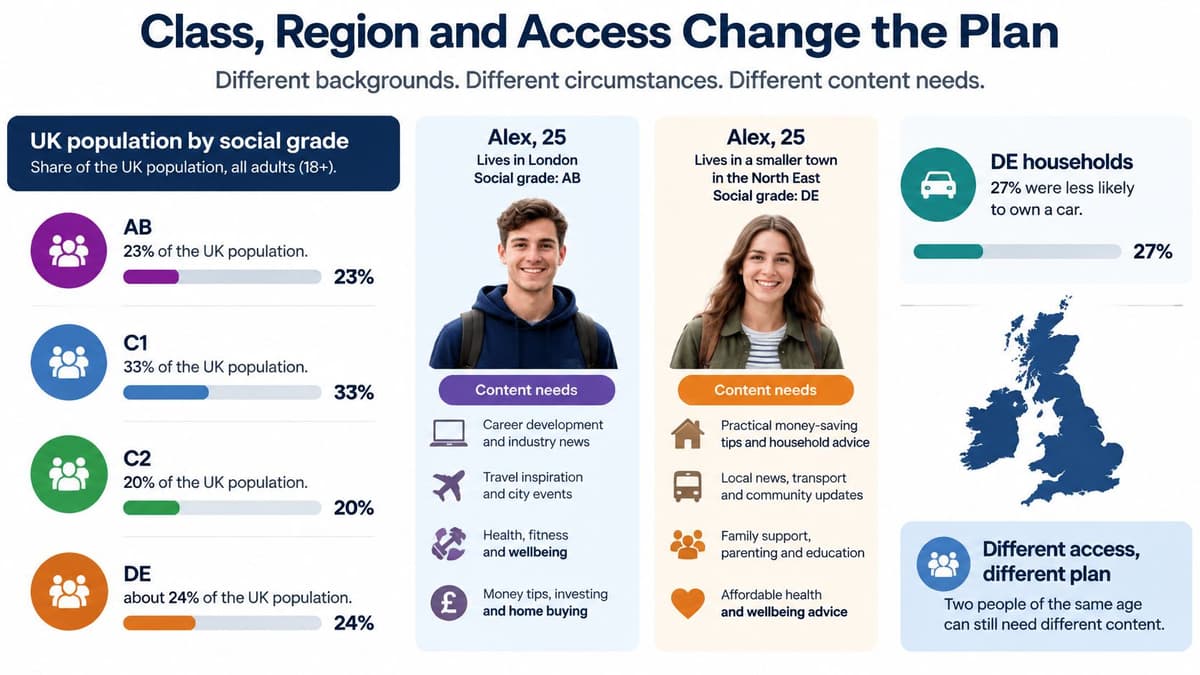
Age is the easiest split to see, so teams often stop there. Two people of the same age can still need completely different content once you account for where they live, what they can afford and how they access media.
Social grade and region shift the message
The Ofcom BBC audiences review classified the UK population as AB 23%, C1 33%, C2 20% and DE approximately 24%. DE households accounted for 27% in the North East of England compared with 17% in the South East, and BBC viewing represented 26% of DE groups' viewing time.
| Group | Measure | Figure |
|---|---|---|
| Social grade AB | Share of UK population | 23% |
| Social grade C1 | Share of UK population | 33% |
| Social grade C2 | Share of UK population | 20% |
| Social grade DE | Share of UK population | about 24% |
| DE households | Share in North East England | 27% |
| DE households | Share in South East England | 17% |
| DE groups | BBC share of their viewing time | 26% |
| Disabled adults | Share of television audience | 21% |
| Disabled adults | Average daily television viewing | 5 hours 20 minutes |
| Non-disabled adults | Average daily television viewing | 2 hours 38 minutes |
That regional gap is large enough to change price framing, local examples and the proof you lead with in a campaign meant for the whole UK. DE groups also watched more television than other social grade groups, so a social only plan can miss part of that audience entirely. If your buyers skew DE and regional, a post built around premium pricing and a London reference may fail for reasons that have nothing to do with your creative quality.
Access needs change the asset, not just the target
Disabled adults accounted for 21% of the total television viewing audience and watched an average of 5 hours 20 minutes per day, compared with 2 hours 38 minutes among non-disabled adults. Don't turn that into a stereotype about viewing habits. Turn it into a production question. Which part of your asset has to change so this group can use it?
- Captions and transcripts: Add them as standard, not as an afterthought when someone asks.
- Alt text and contrast: Write image descriptions that carry meaning and check text is readable on a phone in daylight.
- Simpler paths: Shorten the link journey, use plain language and avoid instructions that depend on precise tapping or sound.
Reach is not the same as usable access. Someone can be counted in your impressions and still be unable to follow your video.
Test it plainly. If region, grade or access adaptations don't change saves, replies, click-through or sales, merge the groups and simplify your life. If they do change results, keep a separate content rule and resource it properly. Before you start inferring sensitive traits about anyone, though, you need to know where the legal line sits.
Choose Segments Within the Legal Limits
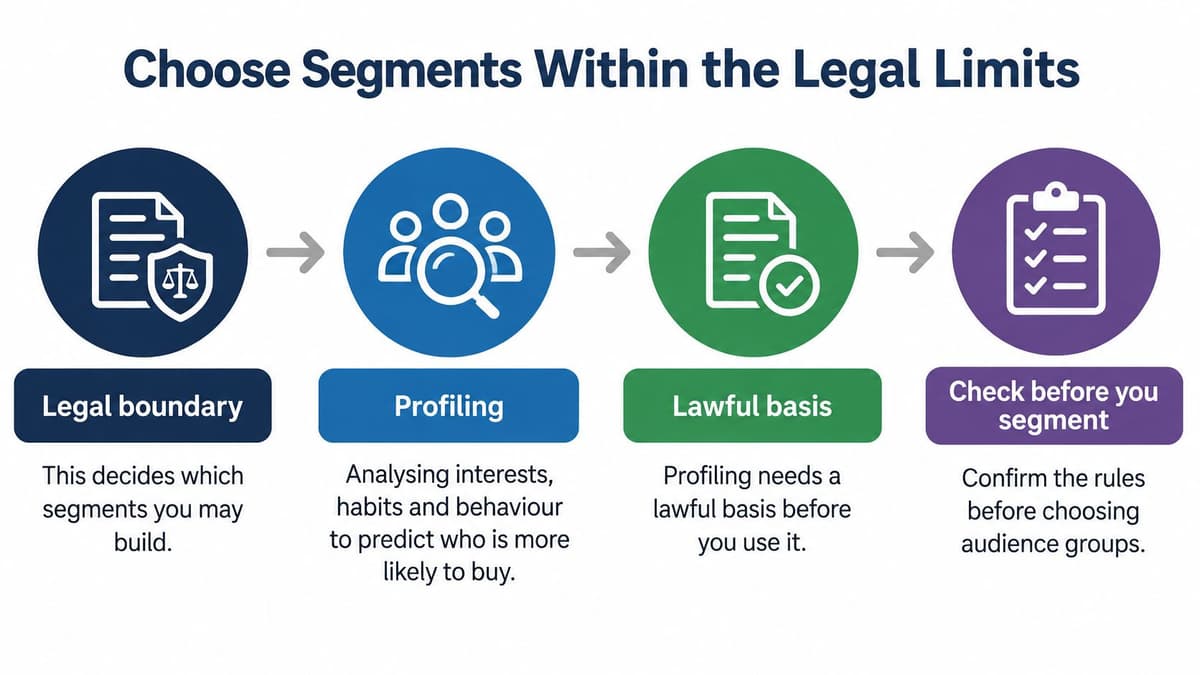
The legal boundary comes first because it decides which segments you're allowed to build at all. Skip this step and you might design a segment you can't lawfully use.
What profiling means for your segments
The Information Commissioner's Office direct marketing guidance defines profiling as analysing people's interests, habits and behaviour, often to make predictions about who is more likely to buy. Under the UK GDPR and Data Protection Act 2018, that activity needs a lawful basis. You must explain that profiling is taking place, why personal information is being used and whether it will be shared with other organisations for direct marketing.
People also have an absolute right to object to direct marketing, including profiling connected with it, and you must honour that objection. There's a stricter layer too. The ICO guidance on planning direct marketing explains that drawing conclusions about a person's race, political opinions or health may amount to using special category data, which needs an additional condition and, for direct marketing profiling, is likely to require explicit consent. Inferred doesn't mean imaginary. Don't treat a guessed sensitive trait as an ordinary demographic segment.
If you're building segments from your own customer relationships rather than bought data, a first-party data strategy gives you a cleaner foundation to work from.
Six steps to a segment you can publish against
- Write the decision first. State what this segment must change, such as channel, hook, offer or posting time. If you can't name the decision, stop here.
- List candidates from data you already hold. Use platform insights, site analytics, customer emails, comments, search queries and sales records before you consider anything new.
- Score each candidate on three tests. It's large enough to matter, you can reach it without guessing private traits, and you'd make a different asset for it. Fail any test and it drops off the list.
- Name it in plain language. Write something a colleague can act on, such as parents comparing after-school activities on Instagram, not Segment B.
- Draft one content rule. Cover format, proof, call to action, access adaptations such as captions or alt text, and what you won't post to this group.
- Set a review date. Revisit after four to six weeks or one campaign, then keep, merge or drop the segment based on evidence.
Safer by default: Prefer public signals such as comments and on-platform insights over named customer lists when you're only deciding what content to make.
Finish by writing a one page segment card for whoever writes or schedules the posts. Include the segment name in plain language, the content rule, the outcome you'll judge it by, and the review date. If it doesn't fit on one page, it's probably too complicated to publish against consistently.
How to Measure and Refresh Each Segment
Measure the behaviour you're studying, on the platform where it happens. Broad social media totals blur exactly the differences you built segments to reveal.
A warning from news use figures
The Ofcom News Consumption in the UK 2025 findings reported Facebook accounted for 58% of people who used social media for news, with platform sample counts of 1,431 for Facebook, 832 for Instagram, 646 for X and 517 for TikTok. Those figures describe use for news, not all social activity, so they aren't universal platform market shares.
That distinction is the whole point. If you copied those proportions into a follower growth plan or an advertising budget, you'd be planning around the wrong behaviour. Always ask what action a figure measures before you let it shape a segment.
Pick one outcome per segment
Give each segment a single result to be judged by. Sensible options include follows from a defined group, saves, replies, click-through, enquiries or sales. Then compare segments on that outcome, plus the time or money each one costs you to serve. Don't compare them on raw impressions, which mostly tell you how big a platform is.
A smaller segment can easily be the more valuable one. Say a local service business gets modest reach from nearby homeowners but those posts produce steady enquiries, while a much larger general audience produces likes and nothing else. The smaller group deserves more of the calendar. For a structured way to set those comparisons up, performance benchmarking helps you define what good looks like before you start judging results.
If you later use paid promotion to revisit people who've already engaged, segmenting audiences for retargeting ads covers how those groups should be separated so your organic segments and paid audiences don't blur together.
Three signals that a segment needs refreshing
- Content decay: The same format stops earning your chosen outcome. The segment may be fine, but the asset has worn out.
- Overlap: Two named segments respond in the same way to the same content. Merge them and reclaim the production time.
- Migration: Discovery has moved to a different platform. Adapt the content, repurpose it properly or stop, rather than posting everywhere by default.
When you optimise, change one variable at a time, such as the first line of the caption or the channel, while the segment definition stays stable. That way you learn what caused the change. Only revisit the definition itself when the outcome gap between segments disappears, because at that point the split has stopped telling you anything useful.
Social Examples for Creators Shops and Agencies
Abstract rules are easy to nod at and hard to use. These three scenarios each start with one audience contrast and end with one publishing decision.
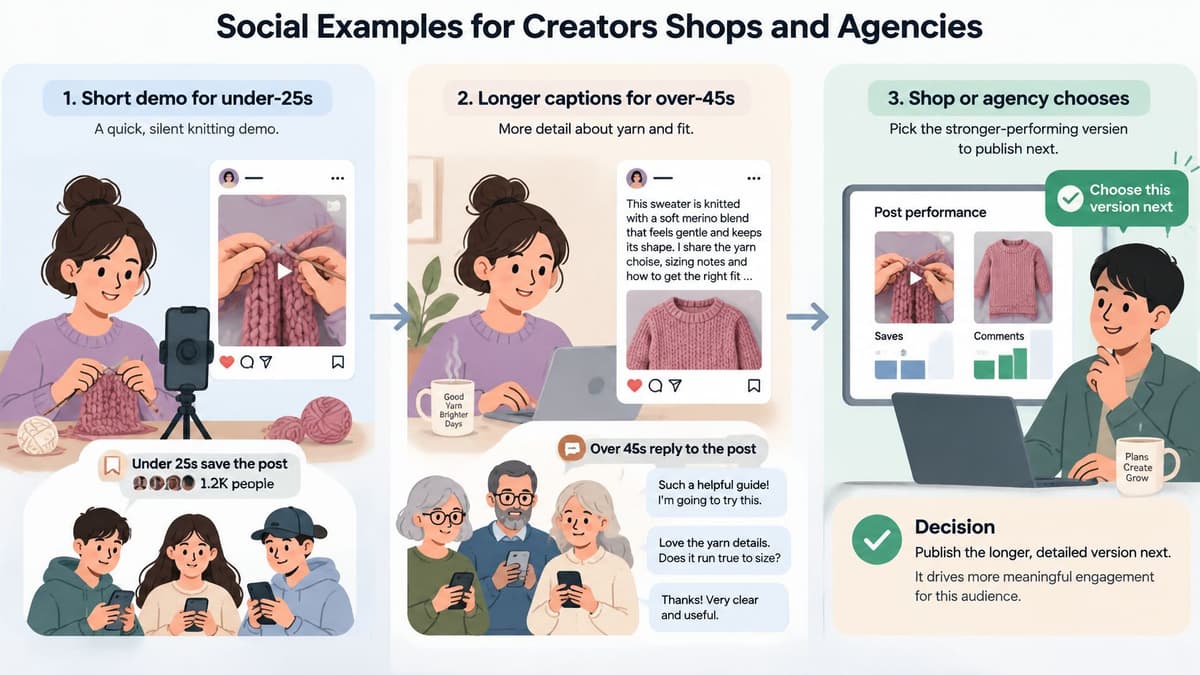
The illustration below shows how different segment rules translate into different content on the same calendar.
A knitting creator with two reading habits
Say a knitting creator notices under 25s save short, silent stitch demos, while over 45s reply to longer posts about yarn choice and fit. She doesn't paste one caption across both. She keeps two assets, a discovery short with captions burned in and a deeper carousel that answers the fit questions in text. Each gets judged differently, saves for the short and replies for the carousel.
A neighbourhood café with two reasons to visit
A café sees weekday Instagram reach from nearby office workers and Facebook comments from regulars asking about weekend hours. The split changes the offer, not just the graphic colour. Office workers get lunch deals posted before midday. Regulars get community events and opening hours. If you're working through the basics of this for a local business, social media marketing for small business covers the wider planning that sits around segment decisions like these.
The video below works through how a small team turns those kinds of audience contrasts into a repeatable posting routine.
An agency that refuses one calendar for everyone
An agency handling three clients refuses a single calendar labelled UK consumers. Each client gets segments tied to a business result, and captions and alt text are checked before anything is approved. That discipline is what stops segmentation collapsing back into one post copied everywhere under deadline pressure.
When manual posting no longer fits those rules, compare real schedulers against the job in front of you. Later and Publer are reasonable starting points for visual, multi-network queues. Planable and Sprout Social suit client approvals and reporting. Buffer and SocialBee fit smaller teams that want a simpler queue. Typefully makes sense when X or LinkedIn writing is the main job, while Hootsuite, Metricool, Vista Social and Postiz suit broader reporting needs or several clients at once.
No tool is best for every segment, and each has trade-offs in price, platform support and workflow. Prices and plan details change, so confirm them on each vendor's site before you commit. You can browse the full list of social media schedulers, use head to head scheduler comparisons, open a platform page such as the best schedulers for Instagram, or start from a need such as schedulers for agencies. The directory compares tools. It doesn't schedule posts itself.
Keep Two Segments and Compare Schedulers
Don't try to run seven segments next week. Keep two or three that change a real asset, retire the rest, and write one content rule for each one you keep. Judge every rule by its chosen outcome, and merge anything that stops behaving differently.
Check each rule against the legal limits before any profiling based segment goes live. Keep public, non-identified platform insights for content decisions separate from named marketing lists, because those two things carry different obligations. If planning that work across a whole month feels daunting, monthly content planning for creators offers a practical structure you can layer your segment rules onto.
When manual posting no longer fits your rules, compare tools against them rather than against a feature list. Scheduler.social is an independent directory that reviews and compares social media scheduling tools, and it does not schedule or publish posts. Start with the complete scheduler directory, use side by side tool comparisons for your shortlist, then open the page that matches your segment, such as schedulers for Instagram or schedulers for solo creators. Tool details and prices change, so check each vendor's site before deciding.
You've now got a way to split your audience into groups that change what you publish, and a test for keeping only the ones that earn their place. When you're ready to put those segment rules into a workflow, compare real scheduling tools side by side at Scheduler.social and pick the one that fits your channels, your approvals and your reporting needs.