First Party Data Strategy for Better Marketing
Build a first party data strategy that improves personalisation, measurement and trust while respecting UK privacy and consent requirements.

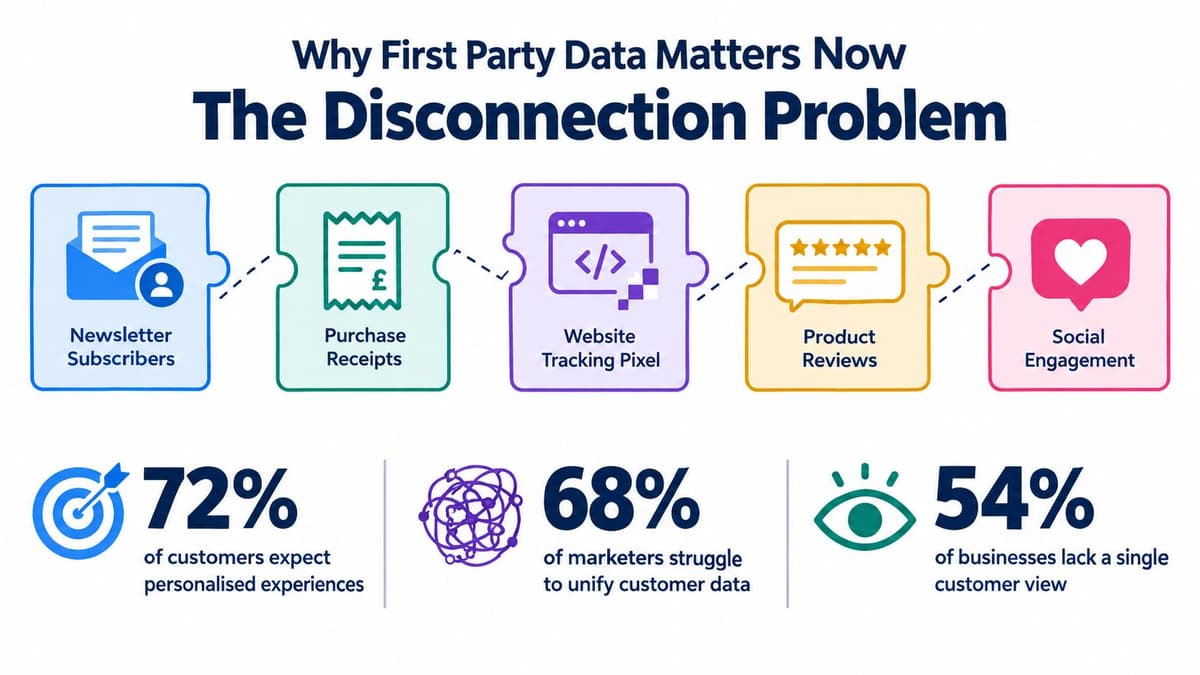
Your newsletter subscribers sit in an email platform, purchase records live in the CRM, and website events belong to whoever manages analytics. Meanwhile, someone's collecting product reviews and reporting social engagement. You have plenty of signals, but answering a simple question, such as which customers should receive a particular message, still requires guesswork.
A useful first party data strategy fixes that decision problem. It connects evidence, identity, permission and accountability so your team can act confidently, without assuming that everything collected directly is available for every marketing purpose.
Table of Contents
- Why First Party Data Matters Now
- Defining a First Party Data Strategy
- Choosing the Right Data Signals
- Building the Core Capability Stack
- Protecting Data Through Consent and Governance
- Applying First Party Signals to Social Workflows
- Building a Practical Implementation Roadmap
- Turning the Strategy into Durable Decisions
Why First Party Data Matters Now
Collecting customer information isn't the same as making it usable. A purchase tells you something different from a newsletter subscription, and neither proves that someone wants personalised advertising. Your team needs agreed interpretations before it needs more integrations.
The UK evidence shows how far recognition can sit from execution. In research cited in coverage of Twilio's 2023 State of Customer Engagement Report, 89% of companies believed first-party data improves customer experiences, yet only 14% of UK organisations mainly used it and 5% used it exclusively, according to the UK report coverage.
Treat disconnection as an operating problem
The disconnected-touchpoint illustration below captures the practical challenge. Treat its percentage callouts as illustrative, not as evidence for setting targets.
Buying a central database won't decide whether a review submission belongs in an email segment. Nor will it resolve disagreements between marketing, analytics and customer service about what a customer record means. Those are management decisions, supported by technology rather than delegated to it.
Start by asking what should change when a signal arrives:
- Meaning: Does the event indicate a declared preference, a completed transaction or merely possible interest?
- Authority: Which team owns the interpretation and can approve its use?
- Action: Should it change content, suppress a message or inform aggregate reporting?
- Evidence: What outcome would justify continuing that action?
The commercial case is stronger when you frame the work around these questions. Better personalisation is useful only when you can explain why a person received something and whether it helped.
Practical rule: Don't approve a new collection point until someone can name the decision it will improve.
The priority isn't collecting everything before identifiers become harder to use. It's establishing dependable data roles, a workable architecture, appropriate permissions and a repeatable process for testing marketing decisions.
Defining a First Party Data Strategy
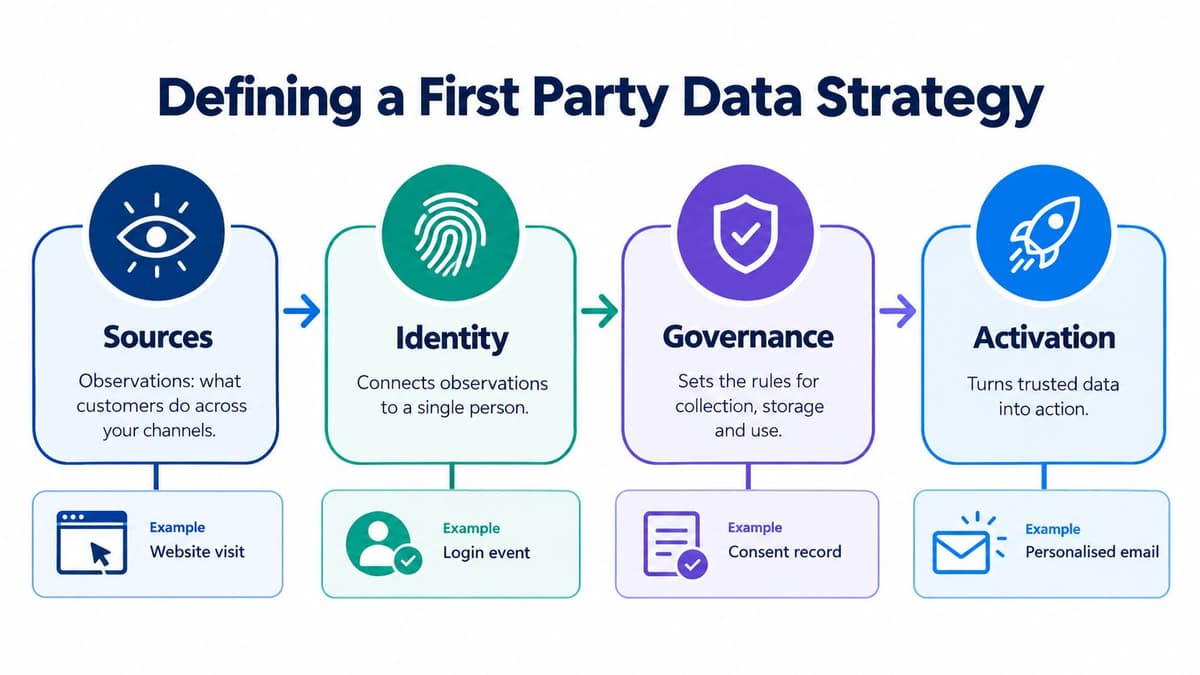
Think of a customer briefing prepared for a colleague. Observations describe what happened, identity establishes whose record you're discussing, governance limits what your colleague may do, and activation turns the briefing into a useful next action.
That sequence provides a practical definition: a first party data strategy is the coordinated set of choices governing directly collected information, reliable records, permitted uses and measurable outcomes. It's an operating model, not an inventory of owned channels.
The relationship between those choices is straightforward:
Separate observation from interpretation
A customer record, a declared preference and an inferred interest aren't interchangeable. A transaction records a purchase. A preference form records what someone expressly selected. Repeated visits to a comparison page might suggest interest, but they don't establish a purchase intention.
For a terminology refresher, Data Hunters Agency's guide to what is first party data provides a useful starting point. Your internal definitions should go further by recording how each field was obtained and how confidently your team can interpret it.
| Record type | Example | Recommended interpretation |
|---|---|---|
| Customer record | Completed order | Evidence of that transaction |
| Declared preference | Selected platform interest | Expressed preference, subject to change |
| Behavioural event | Comparison-page visit | Possible interest, not a confirmed need |
| Derived attribute | Inferred lifecycle stage | A modelled judgement requiring validation |
Define the decision before the audience
Operational measurement asks whether a process worked. Personalised activation changes an individual's experience. Keep those jobs distinct, even when the underlying event could inform both.
The accompanying video provides another introduction to the topic:
Write each proposed use case as a decision statement: use an appropriate preference to select relevant editorial content, use a current suppression record to prevent unwanted contact, or use aggregate results to improve reporting. If the team can't finish that sentence clearly, the collection project isn't ready.
Choosing the Right Data Signals
Don't force every marketing job onto first-party data. Use it where a direct relationship provides useful evidence, and acknowledge where your own records offer little visibility.
UK B2B research identifies that limitation explicitly: first-party data is concentrated among existing customers and often contains fewer data elements, making it weaker for net-new prospecting and expansion into unfamiliar markets. In the same research, 63% of UK B2B marketers planned to increase its use, while lack of high-quality data was the most frequently cited critical challenge, according to Anteriad's UK B2B Marketing Edge report.
| Signal | Best-fit job | Main limitation |
|---|---|---|
| Direct customer records | Retention, lifecycle messaging and suppression | Limited view beyond known relationships |
| Declared preferences | Relevant content and recommendations | Preferences become outdated |
| Behavioural events | Journey analysis and interest prioritisation | Ambiguous without context |
| Contextual signals | Selecting relevant environments or topics | Don't establish individual intent |
| Governed external data | Research, account prioritisation and prospect discovery | Requires separate quality and permission checks |
Match the evidence to the marketing job
For retention, start with transaction history, service interactions and explicit preferences. For suppression, prioritise reliable exclusion records over speculative interest scores. For acquisition, consider contextual placements, partnerships or external research rather than pretending your customer list describes everyone worth reaching.
A contextual decision might place relevant material alongside an article about agency workflows. It doesn't require concluding that every reader works at an agency. That distinction matters when your team wants relevance without building an individual profile.
Social reporting needs equally careful boundaries. A platform's reported reach and your own identifiable audience answer different questions, so agree how reach is measured before combining figures or declaring audience growth.
Make enrichment earn its place
Require an external field to solve an observable gap. Document its origin, permitted purpose, recency and expected effect on a decision before importing it.
- Reject decorative attributes: Don't buy fields merely because a supplier offers them.
- Preserve uncertainty: Mark inferred values rather than presenting them as customer declarations.
- Test relevance: Check whether the additional information changes a useful decision.
- Review permissions: Don't assume a supplier's assurance covers your intended use.
A first-party strategy should favour trustworthy evidence, not impose a blanket ban on every non-owned signal.
Building the Core Capability Stack
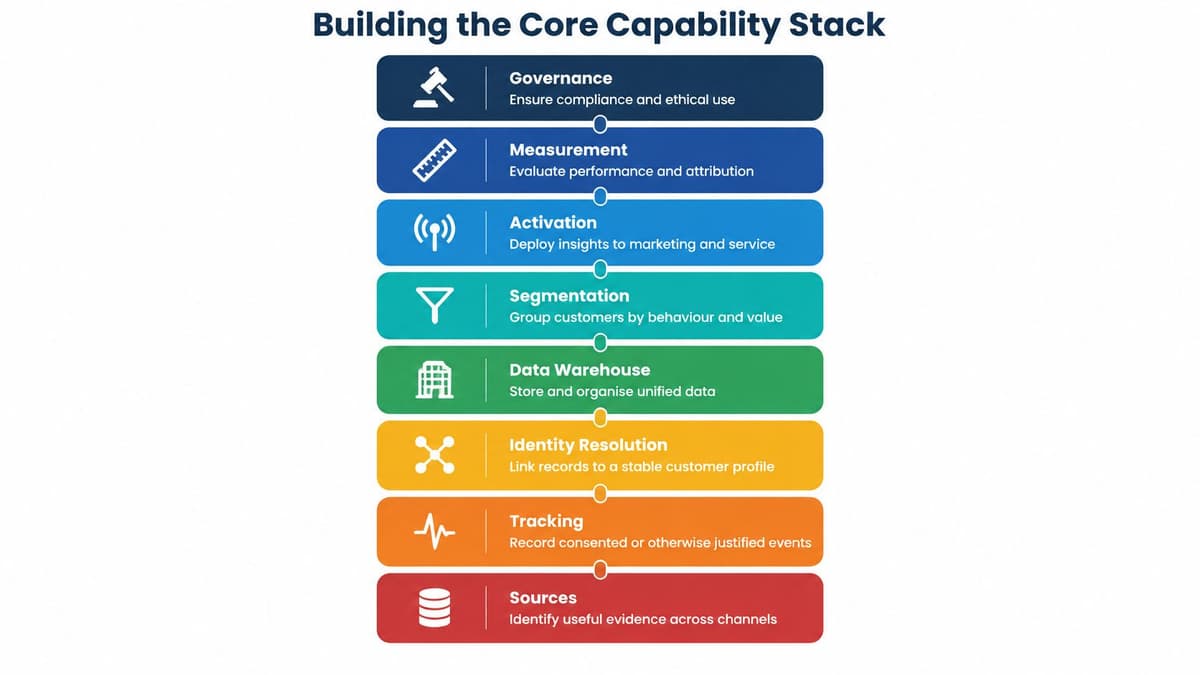
Build a connected operating stack, not a collection of disconnected projects. Each component should receive an understandable input and produce something the next component can use.
The architecture below is a useful organising model. It isn't a requirement to purchase a separate product for every layer.
Connect collection to reliable records
Sources establish useful evidence. For example, a preference form should produce a documented preference record, not an unexplained text field that nobody owns. Catalogue the source, its purpose and the person responsible for maintaining it.
Tracking translates an interaction into an event. A comparison-page interaction might produce an event name, collection time and permission context. Avoid event names that conceal interpretation: comparison_viewed is clearer than labelling the visitor a qualified buyer.
Identity resolution connects records where the evidence supports a join. A verified identifier can support a stronger connection than a shared device or similar name. Keep uncertain records separate rather than manufacturing a complete-looking profile.
Storage preserves usable history and provenance. Its output should let an analyst trace a segment attribute back to its origin, while recognising corrections, expiry and deletion.
Connect records to accountable action
| Capability | Example input | Required output |
|---|---|---|
| Segmentation | Current preference and eligible contact record | An audience with explicit inclusion and exclusion rules |
| Activation | Approved audience and message purpose | A controlled delivery instruction |
| Measurement | Eligible exposure and defined outcome | A result with limitations stated |
| Governance | Policies, owners and processing records | Enforceable access, retention and review controls |
Segmentation needs a business purpose, not just an interesting pattern. Activation should reject an ineligible record rather than leaving the sender to discover the problem later. Measurement should distinguish a recorded response from evidence that the campaign caused it.
Governance applies throughout the stack. The ICO's review of GDPR implementation describes organisations determining legal bases, inventorying information, examining data flows and refreshing consent records. Use those activities as operating disciplines, not paperwork saved for an audit.
A smaller stack with traceable records is a better starting point than an elaborate stack full of unexplained joins.
Before selecting a customer-data platform or warehouse, inspect permission status, recency, provenance, source and observable gaps. Flag orphaned records, duplicate identities and fields with no definition. Technology selection should follow that diagnosis, because another integration won't resolve ambiguity about what the data means.
Protecting Data Through Consent and Governance
First-party does not mean consent-free. Owning the website or collecting information directly doesn't settle whether a particular technology or subsequent use is permitted.
The ICO's guidance on cookies and similar technologies explains that PECR applies to first-party and third-party analytics cookies, and that consent must be actively and clearly given, specific and informed. Don't treat ownership as the legal test.
Classify the purpose and the mechanism
Assess what the technology does. The ICO's storage and access technology guidance covers mechanisms including tracking pixels, link decoration, navigational tracking, local storage, fingerprinting, scripts and tags. Moving collection server-side or using a first-party domain doesn't, by itself, establish an exemption.
There is a narrower route for qualifying statistical measurement. The ICO's guidance on exceptions allows certain technologies used solely to collect visitor statistics to improve a service, subject to its conditions. It doesn't turn individual tracking, profiling, advertising measurement or tracking across services into exempt internal analytics.
| Proposed use | Governance decision |
|---|---|
| Technology claimed to be strictly necessary | Document why the exemption applies |
| Statistical service improvement | Check every condition of the relevant exception |
| Identifiable behavioural analytics | Assess the collection and subsequent processing requirements |
| Advertising or personalised activation | Establish the applicable purpose-specific permissions |
Preserve evidence of permission
Design records so a reviewer can establish what was allowed at the relevant time:
- Purpose and lawful basis: Explain the processing and the basis relied upon.
- Consent evidence: Preserve status, timestamp and the relevant notice or wording.
- Collection context: Record channel, source URL and provenance.
- Lifecycle controls: Include retention rules, expiry and deletion status.
Don't merge measurement eligibility with advertising eligibility. Behavioural advertising storage and access technologies remain subject to consent under the ICO's report on PECR Regulation 6 and online advertising.
Access controls deserve separate attention. When reviewing who can operate connected advertising systems, AdManage.ai's material on safe ad account management is a relevant operational reference, not a substitute for assessing lawful processing.
Release gate: If the team can't demonstrate permission for the intended purpose, keep the record out of that activation.
Applying First Party Signals to Social Workflows
Consider a hypothetical reader choosing an Instagram scheduler. They visit an editorial comparison, explicitly request information about agency needs and separately consent to relevant newsletter updates. Those interactions can support different decisions without becoming a single unrestricted marketing permission.
Scheduler.social is an independent directory that reviews and compares social media scheduling tools, not scheduling software. It has no app, dashboard, calendar, publishing function, sign-up or free trial. The example here describes a proposed editorial data workflow, not a claim about its current tracking implementation.
Follow the signal without overstating it
A comparison-page visit can inform a permitted analysis of content interest. An explicitly requested preference provides stronger evidence of what information the reader wants. A verified review submission supports the integrity of that contribution, but doesn't automatically authorise promotional follow-up.
For this hypothetical workflow, the editorial team could:
- Keep the declaration: Record the reader's expressed agency requirement separately from inferred page interest.
- Check communication eligibility: Use newsletter permission only within its stated scope.
- Select relevant editorial material: Offer an agency-focused comparison rather than assume a particular vendor is suitable.
- Measure the intended response: Evaluate whether the reader uses the comparison, without claiming that a referral proves purchase or satisfaction.
Keep advertising identifiers in a separately permissioned layer. An affiliate click should remain a referral event, not become blanket permission for retargeting or additional marketing.
Keep recommendations independent
A useful editorial prompt would direct the reader to Instagram scheduler options and explain how to assess their requirements. It wouldn't declare a winner merely because someone visited an Instagram-related page.
Buffer, Hootsuite, Later, Sprout Social, Metricool and Vista Social are real options to evaluate. Compare their current strengths and limitations against the reader's actual workflow, and verify capabilities directly with the vendors rather than inferring them from brand familiarity.
The directory's all-tools listings can support an initial shortlist, while its head-to-head comparisons help readers examine alternatives. For an agency, practical evaluation criteria might include client separation, review responsibilities, reporting needs and the effort required to change systems.
Measurement should support editorial quality as well as commercial decisions. Review whether recommendations help readers narrow their choices, preserve visibility into affiliate referrals, and keep commercial incentives separate from eligibility rules. Don't optimise solely for outbound clicks if doing so makes the advice less useful or less neutral.
Building a Practical Implementation Roadmap
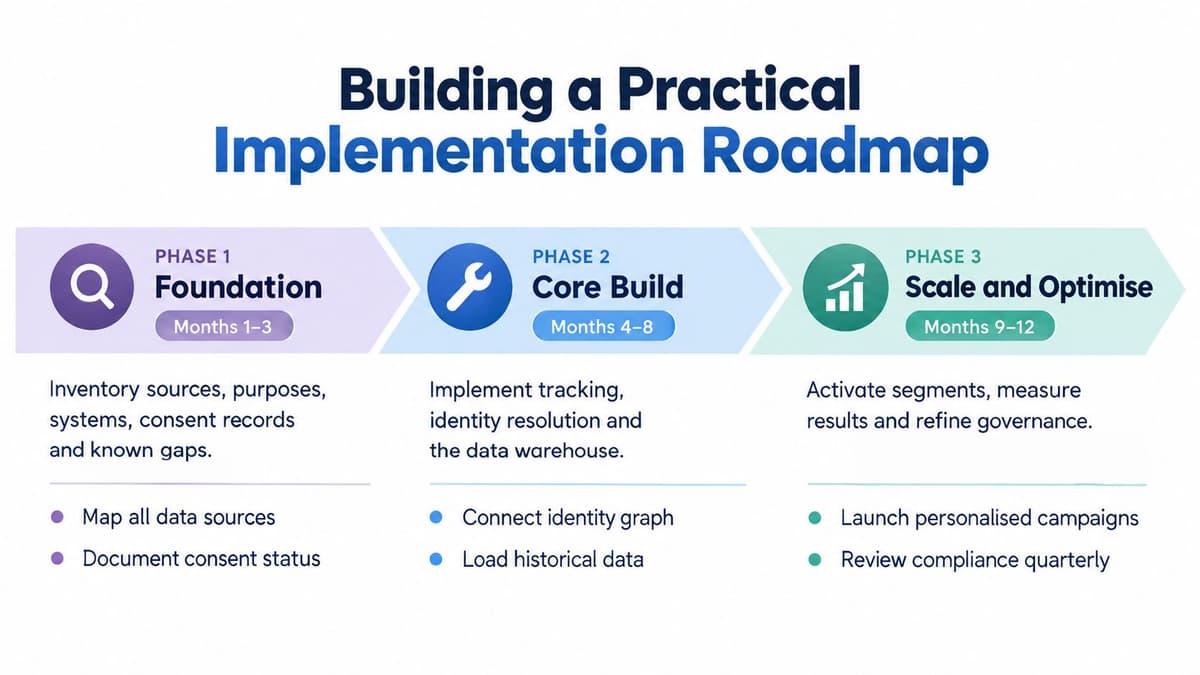
Use phases with readiness gates, not a universal deadline. A small team with clean records may move differently from an organisation untangling legacy systems, so treat the calendar shown below as illustrative planning guidance rather than a benchmark.
Assign owners and exit criteria
During foundation, the marketing owner and privacy lead should inventory sources, purposes, systems, consent evidence and unresolved gaps. Include a social media audit where social reporting or audience information enters the proposed workflow. Finish when the team can distinguish usable records from records needing investigation.
During core build, engineering and data owners should agree event definitions, matching rules, storage requirements and segmentation logic. Require test records that demonstrate corrections, permission changes and deletion propagation before approving production use.
During activation, the channel owner should test a narrowly defined decision with documented exclusions. The analyst should specify the outcome and evaluation approach before delivery, not retrospectively select whichever metric looks favourable.
Establish a baseline before targets
Use explicit KPI definitions so teams don't report incompatible versions of progress.
| KPI | Suggested definition |
|---|---|
| Consented collection rate | Valid opt-ins divided by eligible consent opportunities |
| Data completeness | Applicable required fields populated with valid values |
| Identity-match rate | Eligible records joined under the approved matching rule |
| Audience activation rate | Eligible selected records successfully accepted by the destination |
| Opt-out rate | Opt-outs divided by the defined contacted population |
| Time to deletion | Elapsed time from a validated request to confirmed system completion |
| Business outcome rate | Defined successful outcomes divided by the eligible population |
Specify denominators, exclusions and reporting windows alongside each metric. A rising match rate isn't progress if engineers achieve it through weaker joins, and completeness isn't useful when staff populate missing fields with guesses.
Scale only after review. The business owner should decide whether to continue, revise or stop based on outcome quality, operational effort and privacy risk. Set numerical targets after measuring the baseline, and retain the option to remove a use case that doesn't justify its complexity.
Turning the Strategy into Durable Decisions
The finished product isn't a larger customer table. It's a set of decisions your team can explain, repeat and challenge when circumstances change.
A durable strategy makes accountability visible. Someone owns each use case, understands its dependencies and can stop it when the evidence or permissions no longer support the action.
Apply a readiness test
Before approving another integration or campaign, ask:
- Purpose and ownership: Does every retained field have a justified purpose and an accountable owner?
- Activation authority: Can the team connect each audience rule to an appropriate lawful basis and any required consent?
- Identity confidence: Are joins supported by an acceptable matching approach, with uncertainty preserved?
- Outcome quality: Does the KPI represent a meaningful result rather than convenient activity?
- Deletion coverage: Can a validated request be honoured across destinations, exports and connected systems?
Treat an unanswered question as work to complete, not a reason to write a more ambitious strategy document. A focused process that staff can operate is more valuable than an impressive architecture they can't explain.
Separate data strategy from software selection
Scheduling software addresses publishing workflows. It doesn't decide which customer information you should collect, whether an audience is eligible or what constitutes a worthwhile outcome.
Use the same discipline when evaluating social performance. A framework for measuring social media ROI for SaaS teams can help connect activity to business questions, but your own team must define the relevant costs, outcomes and attribution limits.
When you do need scheduling software, shortlist tools against the workflow you've documented. Compare alternatives through directory listings, head-to-head reviews and relevant platform or agency use-case guides. Check each vendor's current information directly, because prices and capabilities can change.
Buy software to support an agreed operating model. Don't buy it in the hope that the operating model will appear afterwards.
Scheduler.social offers independent reviews and comparisons of real social media scheduling tools, helping you assess the publishing software that fits your wider data strategy. Visit Scheduler.social to compare options side by side, explore platform and workflow guides, and find the right scheduler for your needs.