Employee Advocacy Programs: A Practical Guide
Employee advocacy programs: what they are, the KPIs that matter, and how to keep sharing voluntary. Compare schedulers on Scheduler.social.
A programme should not treat employees' personal accounts as extra corporate channels. It should help willing, informed people decide whether sharing is right for them, with clear boundaries against scripted broadcasting and posting quotas.
Marketing needs credible conversations and measurable outcomes. HR needs fair participation and a trustworthy employee experience. Measure the programme's presence separately from proof of return: more posts alone do not show business value. Sometimes fewer, relevant shares serve both teams better.
Table of Contents
- What Employee Advocacy Programmes Mean in Practice
- A Scorecard for Benefits and Return
- The Five Parts Every Programme Needs
- Keeping Advocacy Voluntary and Fair
- Patterns from Teams That Do This Well
- Why Advocacy Numbers Move Around
- Pick Workflows and Schedulers Then Start Small
What Employee Advocacy Programmes Mean in Practice
Neighbours talk about the local shop where one of them works. They might recommend its service, explain a change or complain about a difficult shift. Those conversations happen whether the shop owner asks for publicity or not.
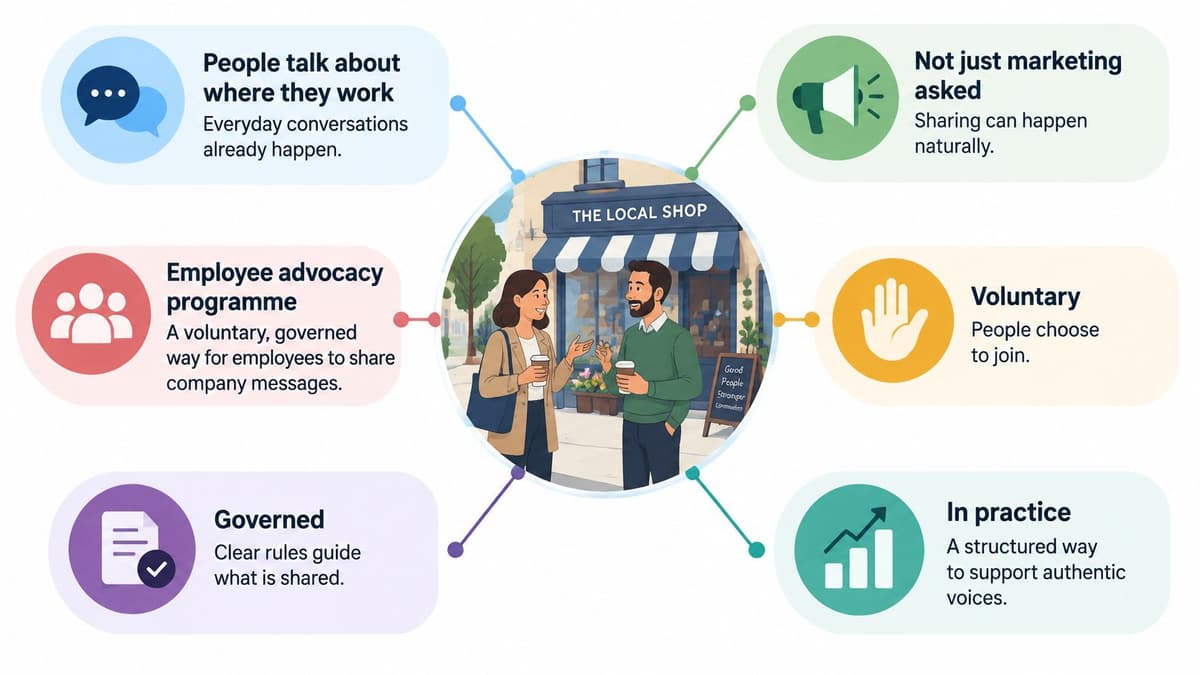
Employees behave similarly online. An employee advocacy programme is a voluntary, governed way for staff to share accurate company news, professional expertise and workplace experiences through their own accounts. It isn't the corporate page, and it isn't the same arrangement as paid influencer work.
The distinction is easier to understand when you separate three behaviours:
- Unsupported informal posting: Someone shares a workplace story without knowing whether the photograph contains confidential information.
- Scripted broadcasting: Marketing asks everyone to paste the same announcement, regardless of their knowledge or audience.
- Informed advocacy: An employee understands an announcement, adds relevant context and decides whether sharing it would help their network.
The diagram shows how natural conversations and organisational guidance fit together.
Informal sharing came before formal programmes
In a 2014 Weber Shandwick and KRC Research survey of 2,300 employees across 15 markets, UK findings included 47% who had posted about their employer, 31% who had shared praise, 11% who had shared criticism, 9% who regretted a post and 54% who had defended their employer, according to HRreview's account of the survey.
The same survey found that only 27% of UK respondents said employers encouraged social sharing, only 49% could explain what their employer did, and just 29% were engaged. Employees were already communicating publicly, but many lacked either explicit organisational support or a strong understanding of the organisation.
That matters more than the supply of ready-made posts. Someone who can't explain a service shouldn't be expected to defend its benefits to prospective buyers.
For professional teams considering LinkedIn, Ploot's guide to activate your team's LinkedIn reach offers a channel-specific starting point. Use that kind of guidance to support relevant conversations, rather than to assign ownership of employees' networks to marketing.
Practical rule: Give people enough understanding to make a good decision about sharing, including the decision not to share.
A workable programme combines a business scorecard, clear operating responsibilities, safeguards against pressure and a small launch. Its credibility rests on understanding and consent, not on the number of corporate posts employees redistribute.
A Scorecard for Benefits and Return
Employees can introduce expertise to relevant audiences, help candidates understand a workplace and start useful buyer conversations. But participation has to be real, and the route from activity to outcome has to be traceable.
In 2025, Oktopost's survey reported through PR Newswire covered more than 770 full-time B2B marketing executives in the US and UK: 55% overall and 62% in the UK reported an active employee advocacy programme, while 76% across both markets actively used LinkedIn. The UK adoption figure describes programme presence, not employee participation, leads, revenue or return.
Advocacy scorecard for a quarterly review
| Measure | Definition | Healthier reading | Weaker reading |
|---|---|---|---|
| Activation | Enrolled employees who share at least once in the period | Participation rises without an appraisal target | Near zero, or universal participation that suggests pressure |
| Contribution | Active advocates divided by enrolled advocates | Stable from month to month | A launch spike followed by collapse |
| Distribution efficiency | Reach per shared asset | Similar to or better than the corporate post of the same asset | High volume with tiny reach per share |
| Engagement quality | Clicks and substantive comments | Comments show the employee added context | Only likes on identical paste-jobs |
| Downstream outcomes | Attributed applications, registrations or qualified leads | A tracked path from shared link to a result | No attribution, so ROI is only a story |
| Trust and opt-out | Comprehension or trust survey plus opt-out rate | Opt-out is easy and resentment stays low | No opt-out, or opt-out rises while posts rise |
Read each measure without inflating it
Activation tells you whether enrolled employees have started. Contribution helps distinguish sustained participation from launch-day enthusiasm. Define an active advocate consistently within each reporting period, rather than changing the definition when results disappoint.
For distribution efficiency, compare the same asset over comparable periods. Don't add employees' follower counts and call the total unique reach, because their audiences may overlap.
Engagement quality asks whether anyone found the content useful. A question about implementation is more informative than a row of congratulatory reactions. Downstream outcomes require tracked links, campaign identifiers and an agreed definition of a qualified result.
The trust and opt-out row prevents a misleading success story. More posts alongside worsening sentiment should trigger a conversation with employees, not a celebration of publishing volume. A practical guide to KPI measurement can help connect activity measures to business objectives.
Trust belongs beside the scorecard
In Edelman's 2022 workplace trust report, My Employer was trusted by 78% of respondents globally, and employers held a 30-percentage-point trust advantage over the four major institutions in the UK. That is context for credible communication, not an ROI calculation.
Edelman's employee-employer findings reported that, among employees who trusted their employer, 78% would advocate, 74% reported greater loyalty, 71% were engaged and living organisational values, and 83% were strongly committed to their jobs and customers; separately, 62% of employees were expected to participate in company social-media activities. These aren't UK-only performance rates.
Read willingness to advocate as an enabling condition and expected participation as a pressure risk to investigate. Neither is a lead, a sale or proof of programme value.
Review the scorecard quarterly. If finance needs an ROI figure, include staff time, administration and software costs, then distinguish attributed outcomes from incremental returns. Programme presence alone is never a return calculation.
The Five Parts Every Programme Needs
A content library is like a script: it won't produce a convincing performance if the cast doesn't trust the play. Begin with internal understanding and clear responsibilities before asking employees to communicate externally.
The Institute of Internal Communication's employee advocacy resources describe findings with Ipsos Karian & Box that external audiences are more likely to trust organisational information from employees than from branded accounts, alongside Great Place to Work's UK findings of 6.25 times higher revenue per employee in Best Workplaces, and proximity-leadership scores of 54% on average versus 88% in those workplaces. Those comparisons do not prove advocacy causes higher revenue.
They do give communications and HR a reason to examine the internal environment before optimising public sharing. Managers should explain decisions clearly and answer difficult questions, not just forward marketing requests.
The visual summarises the wider operating system around that work.
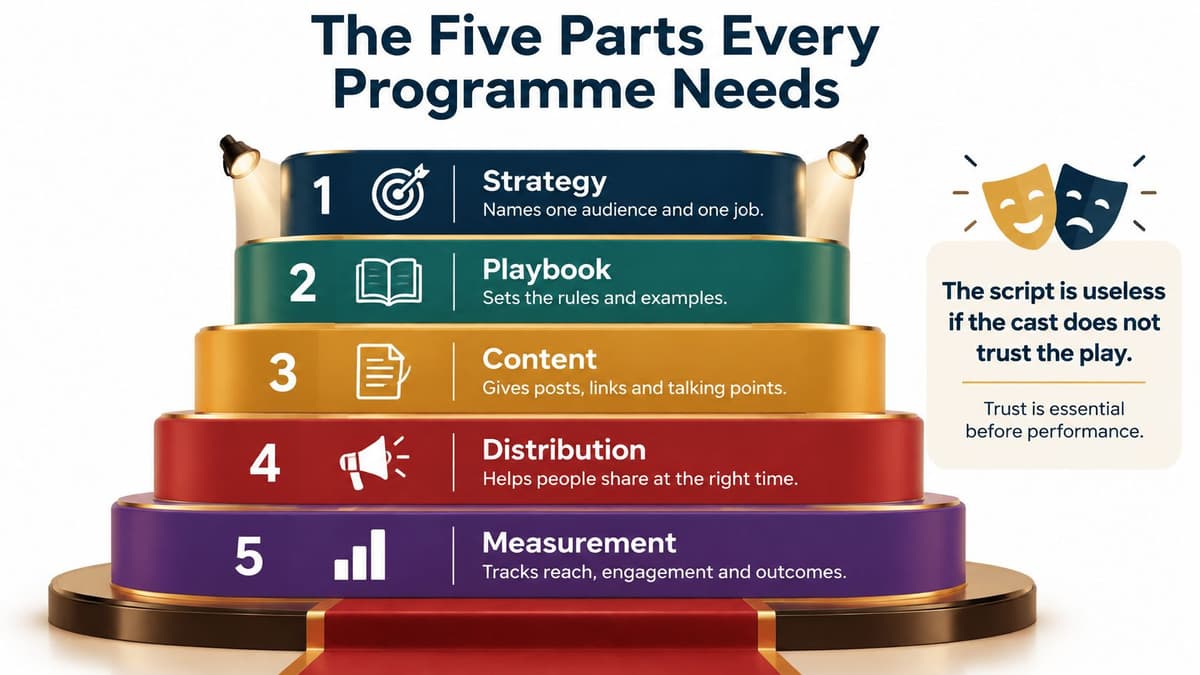
Build the operating parts in order
Strategy comes first because it determines what belongs in the library. A specialist consultancy might prioritise buyer education; an employer recruiting locally might choose workplace stories. Trying to serve every audience creates vague content that nobody feels qualified to share.
Five parts in build order
| Part | Order | What it decides | Done when |
|---|---|---|---|
| Strategy | 1 | One audience and one job, plus who is not expected to post | The exclusion is written down with the goal |
| Content | 2 | A small editable library, employment disclosure and a ban on indefensible claims | Staff can add their own sentence and a disclosure line |
| Training | 3 | What may be shared, what stays private, how to personalise and how to decline | Someone can refuse without a manager chase |
| Governance | 4 | Brand, employment and regulatory rules, manager behaviour, risk-based approval and an audit trail | A risky post has an owner and a record |
| Incentives | 5 | Recognition, time and early information, never a posting quota | Sharing is absent from appraisals, bonuses and league tables |
For content, supply the underlying facts as well as suggested wording. An engineer explaining a product decision needs the reasoning, limitations and approved public information, not just an enthusiastic caption.
Training should involve a practical edit. Ask participants to remove confidential details, add a personal explanation and make the employment relationship clear. Include an example where the correct action is not to publish.
Make governance proportionate
Marketing should own campaign accuracy, HR should protect fair participation, and a named specialist should assess regulated or sensitive claims. Managers need explicit guidance too: repeated reminders can turn an optional invitation into an apparent obligation.
A social media approval workflow guide can help teams define reviewers and escalation routes. Reserve additional review for material risk rather than routing every harmless personal observation through a committee.
Keep incentives modest and useful. Offer working time to prepare a thoughtful contribution, early access to relevant information and recognition that the employee is comfortable receiving.
When evaluating software, favour consent, auditability and a clear distinction between original employee contributions and centrally scripted distribution. A system that makes everything look like voluntary endorsement can obscure the very difference you need to understand.
Keeping Advocacy Voluntary and Fair
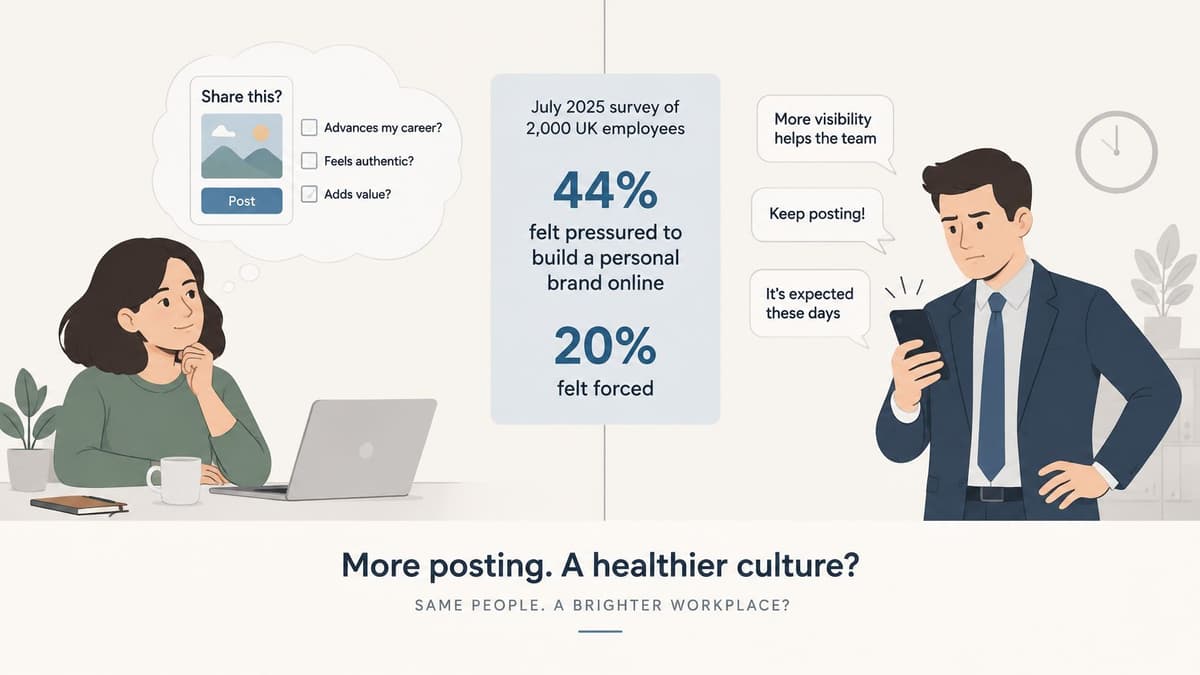
In a July 2025 survey of 2,000 UK employees, 44% felt pressured to build a personal brand online, 20% felt forced to engage online despite lacking time, and 19% felt expected to keep creating content, sharing career updates and networking, according to NatWest Mentor's account of what UK employees want from work. More employee posts aren't automatically evidence of a healthier culture.
The contrast below captures an important distinction: an opportunity to contribute can feel very different from an expectation to perform publicly.
An employee may value their job and still prefer a private online life. Confidence, disability, caring responsibilities, cultural norms and the nature of someone's role can all affect whether public posting feels appropriate.
Managers shouldn't interpret those preferences as disengagement. Otherwise, marketing may gain distribution while HR loses trust and inclusion.
Safeguards managers can apply
- Record the choice: Make joining and leaving explicit, explain what information is collected and provide a straightforward withdrawal route without requiring a defence.
- Offer another contribution: Invite employees to review a technical claim, suggest a customer question or contribute to an internal story without posting publicly.
- Remove career consequences: Keep advocacy out of performance ratings, bonus rules and manager league tables. Don't praise public participation in ways that imply quieter colleagues lack commitment.
- Read sentiment alongside clicks: Ask whether invitations feel optional and whether employees can decline comfortably. Investigate rising withdrawals without chasing individuals to rejoin.
A helpful manager response is to thank someone for considering the invitation and accept their decision. Asking again through successive team meetings can undermine the original promise of choice.
Use the video as a discussion prompt about expectations around professional visibility.
Optional doesn't mean ungoverned
Regulated or customer-facing staff may still need guidance about disclosure, confidentiality and claims when discussing work on personal accounts. Have the appropriate internal specialist define those boundaries without implying that employees must post.
Avoid requesting access to unrelated personal activity. Collect what you need to administer the programme and assess its stated outcomes, rather than treating participation as permission to monitor someone's entire online presence.
A credible programme can explain its business value without treating employees' personal accounts as an unpaid extension of marketing.
Patterns from Teams That Do This Well
These are composite illustrations, not audited case studies or vendor results. Each shows how an employer might design advocacy around a useful constraint rather than a publishing target.
Expertise at a B2B consultancy
A consultant writes a short LinkedIn explanation of a problem buyers regularly encounter. The practice lead owns the reference library, checks technical facts and supplies a tracked link to a relevant resource.
The consultant can rewrite the introduction, add their own reasoning and choose not to share. A short disclosure makes the employment relationship clear. The most useful result is a qualified conversation with a relevant prospect, not compliance with a posting schedule.
Workplace stories at a retailer
A store colleague wants to describe how their team supported a new starter. The employer-brand lead owns the story library, while the colleague chooses their wording and checks that anyone pictured is comfortable appearing.
Product claims remain on the brand account. A colleague who doesn't want to publish can contribute an offline quote, subject to agreement about its use. HR pays particular attention to whether staff feel free to refuse.
Controlled communication at a regulated firm
A specialist drafts a personal post whose wording could be interpreted as financial advice. The compliance lead owns the approved reference library and arranges a focused review before publication.
Employees can adjust personal context, but changing a substantive claim triggers another check. The team accepts deliberately low activation rather than encouraging people to publish material they don't understand or can't safely discuss.
Three advocacy patterns and the row that matters
| Setting | What people may share | Constraint | Scorecard row |
|---|---|---|---|
| B2B consultancy | Short LinkedIn explainers the consultant wrote, with a tracked link and employment disclosure | No posting quota; the practice lead owns the library | Downstream outcomes, counted as qualified conversations |
| Retailer | Voluntary culture and hiring stories; product claims stay on the brand account | Store staff can contribute an offline quote instead of posting | Trust and opt-out |
| Regulated firm | Personal posts after a short approval when wording could be financial advice | Low activation is accepted as the cost of compliance | Activation, read as deliberately low |
None of these patterns establishes a revenue multiple. Nor does a quiet cohort automatically represent a failed programme: some employees may contribute valuable expertise without becoming public advocates.
Copy the constraint that matches your risk, not another industry's posting volume. A retailer's informal culture story and a regulated specialist's professional commentary need different boundaries.
Why Advocacy Numbers Move Around
A high advocacy score does not prove that employees trust the programme, and a drop does not automatically mean they have stopped supporting the organisation. Numbers only make sense alongside the question asked and the way responses were counted. In Hive's UK benchmark reporting from more than 500,000 employee responses, the Engagement Index fell from 7.5 in Q3 2025 to 6.7 in Q4, its lowest recorded level, and the advocacy score fell to 6.8.
An index and a percentage are not interchangeable. They may describe different questions, employee groups or calculation methods, so comparing them directly can give a misleading picture.
Diagnose before changing content
A benchmark can move because of its sample, sector, timing or question wording, even if a particular team's behaviour has not changed. First check what was measured: willingness to recommend the employer, willingness to recommend its products, or actual social posting. These are related, but they do not show the same thing.
When advocacy numbers fall
| Signal | Possible cause | Check first |
|---|---|---|
| Posts stay high while the advocacy score falls | Fatigue or scripted sharing | Sentiment, and whether posts are identical paste-jobs |
| Engagement and advocacy fall together | Workload, pay or leadership trust | Internal signals, not the publishing tool |
| One department stops sharing | Local pressure or a live grievance | Split results by team and employment type |
| Approved posts continue in a crisis | Habit without belief | Pause non-essential asks; don't treat shares as endorsement |
| Two benchmarks disagree sharply | Different samples and methods | Compare your own cohort over time, including non-participants |
Set a baseline for trust, belonging and understanding. Keep the survey wording consistent between reviews, or a changed question may look like a change in employee sentiment. Advocacy is voluntary behaviour that follows trust, not a content pump.
Where group sizes allow confidentiality, compare results by department and employment arrangement. A company-wide average can hide a team dealing with a demanding restructure or an unresolved management problem.
Separate platform problems from workplace problems
If employees cannot find approved assets, improve navigation. If they do not believe leadership's explanation of a decision, adding more content will not fix the problem. Communications leads need a clear route to raise that concern with HR and senior management.
Compare participants with non-participants over time, but do not assume the programme caused every difference. Volunteers may have been more enthusiastic before joining, so the comparison alone cannot show that advocacy created the difference. Programme activity is evidence that a programme is present, not proof of return on investment.
During a crisis, continued sharing calls for caution. Employees may be following a routine or worry that silence will be noticed. Pause non-essential promotional requests and give people accurate internal information before asking for external support. Reach without consent can damage trust.
Diagnostic discipline: Before relaunching the library, name the likely cause of the decline and identify what evidence would challenge that explanation.
A useful review assigns an owner and an action. That could mean improving an approval route, addressing workload or stopping the pilot, rather than asking marketing for more content by default.
Pick Workflows and Schedulers Then Start Small
Use a 90-day pilot as a practical planning window, not a promised route to results. Keep the scope narrow enough that marketing and HR can understand what happened.
- Establish the baseline. Measure trust and comprehension, and document the initial invitation and opt-out offer before building the library.
- Choose a channel and outcome. LinkedIn is a sensible candidate for professional teams. Select a specific result, such as applications or qualified enquiries.
- Enrol volunteers. Confirm in writing that posting isn't part of appraisal.
- Prepare editable material. Supply accurate assets, personalisation guidance and a clear employment-disclosure line.
- Review at day 90. Assess every scorecard row. Stop or narrow the pilot if resentment or withdrawal increases.
- Assess tools afterwards. Buy against an observed workflow problem rather than an imagined need for scale.
Keep corporate publishing separate
Most social schedulers are designed around brand or client accounts. They aren't automatically employee-advocacy platforms. Use a scheduler for corporate publishing and assess any separate personal-account arrangement for informed consent, permissions and withdrawal.
For a shortlist, consider Buffer and Later for simpler smaller-team workflows, Planable where approval coordination matters, and Hootsuite, Sprout Social and SocialBee for broader workflow requirements. Simplicity can become a limitation as governance grows, while a broader system can add unnecessary administration to a modest pilot.
Check current LinkedIn support, approval arrangements and analytics against your actual account types. Don't assume every tool supports the same personal-profile actions, reporting or permissions. Review the practical steps to schedule social media posts before testing a corporate publishing workflow.
Choose the scheduler for the brand's operational needs. Employees' willingness to speak remains a separate human decision.
Scheduler.social is an independent directory that reviews and compares social media schedulers, not a publishing tool. Explore all schedulers, use head-to-head comparisons, and check options for LinkedIn and approval workflows against your brand's requirements. Visit Scheduler.social to find the right scheduler for your corporate workflow while keeping employee advocacy voluntary.