Brand Reputation Monitoring: A Practical Guide for 2026
Learn how brand reputation monitoring works: the channels to watch, metrics to report, fake-review checks and a triage workflow for response.
You open the review page the morning a campaign is due to go out. The average looks tidy, almost too tidy, and someone wants that number in the subject line. At the same time a short forum thread describes a delivery failure that three customers have already repeated in nearly the same words. One of those signals will change whether a stranger buys. The other might be noise, or worse, a pattern that only looks clean.
Brand reputation monitoring is how you tell them apart before you reply, quote a rating, or spend more on ads. It is continuous watching, not a one-off audit, and it treats authenticity as part of the job rather than a later clean-up.
Table of Contents
- What Brand Reputation Monitoring Covers
- Why Reputation Signals Affect Revenue and Retention
- Channels and Signals Worth Watching
- Spotting Fake Reviews and Manipulated Signals
- Metrics and Reporting That Show Real Change
- How to Run Alerts, Triage and Escalation
- Best Practices and Governance Habits
- Choose Monitoring Tools That Fit Your Workflow
What Brand Reputation Monitoring Covers
A smoke alarm does not put out a fire and it does not redesign the kitchen. It tells you early that something is burning, while you can still act. Brand reputation monitoring works the same way for public opinion.
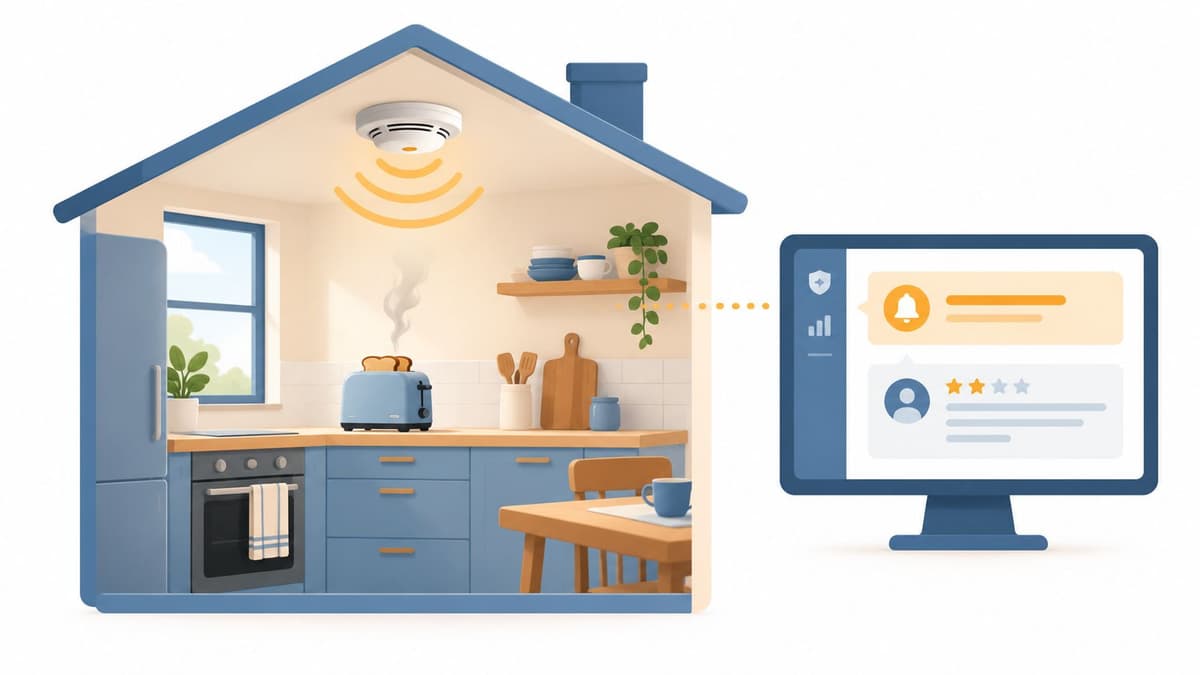
In one sentence, it is the continuous tracking of what people say about a brand across reviews, search results, social platforms, forums and creator content, combined with scoring and routing. Scoring covers rating, sentiment, volume and themes. Routing means each signal reaches the person who can do something about it.
Three questions the work answers
It covers three things, and teams get confused when they collapse them into "mentions".
What is being said. Praise, complaints, comparisons and claims about the product, the service or the people behind it.
Where it is being said. A one-star review, a news result, a creator post and a staff review site do not carry the same weight, even when the words look similar.
How fast it is changing. A slow drift in rating is a different problem from a spike overnight. Speed tells you whether you have a week or an afternoon.
Neighbouring jobs use some of the same screens, which is why ownership gets muddy. The boundaries below keep the alarm from being asked to cook the meal.
| Discipline | Core question | Usual owner | Typical output |
|---|---|---|---|
| Brand reputation monitoring | Is what people say about us changing, and does it matter? | Marketing, communications or brand lead | Alerts, scored trends and a regular report |
| Social listening | What topics and conversations surround our category? | Marketing or insights team | Topic and sentiment reports |
| Customer support | How do we resolve this person's problem? | Support team | Ticket resolution and response times |
| Reputation management | How do we shape the story and rebuild trust over time? | Communications, PR or leadership | Campaigns, response strategy and outcome reviews |
Monitoring is the early-warning layer. Listening maps the wider conversation. Support fixes one person's problem. Reputation management is the longer effort to shape perception and rebuild trust once you know what the signal means.
Why Reputation Signals Affect Revenue and Retention
Customers now read other customers' experiences before they ever contact a business. Company claims still matter, but they arrive after a stranger has already formed a view from public evidence. That shift is why a communications lead should treat reviews as a commercial signal, not a side inbox.
UK research in 2025, based on more than 2,000 consumers and over 600 small and medium-sized businesses, put independent review platforms first among information sources. 84% of consumers ranked them ahead of social circles at 83%, professional endorsements at 68%, company websites at 52%, and advertising at 50%, according to Trustpilot's UK growth research. Among decision-makers, 91% agreed that positive online reviews can contribute to revenue growth, and 85% said reviews can help a business enter new markets.
The four-star line
Thresholds matter as much as volume. In a 2023 survey of 2,503 UK consumers, 94% said reviews influenced a purchase decision in some way, 68% looked for an average of at least four stars before engaging with an online store, and only 3% would engage with a business averaging one or two stars. Reviews also helped 62% of respondents find online stores, as set out in REVIEWS.io's buyer report.
A rating that slips from a comfortable four-star average toward one or two stars is not a cosmetic dip. It can decide whether a prospect even opens the page.
Consider a product page at 4.4 stars. A delivery fault pushes it toward 4.0 across three weeks. The team watching the change sees the slide in week one and can fix the cause while the page still looks credible. The team that checks quarterly notices only after conversion has already fallen. Monitoring protects acquisition, retention and the chance to enter new markets. The exact measures belong in the reporting routine later. The point here is simpler. Slow detection costs you the window in which a reply and a fix still change the story.
Channels and Signals Worth Watching
A customer's first impression may come from any channel, including one you do not post on. Monitoring has to follow the places people talk, not only the brand's own accounts. If you only watch tagged comments, you miss the candid version.
A practical map looks like this.
| Channel | Signals to watch | Why it matters | Suggested check frequency |
|---|---|---|---|
| Review platforms (for example Trustpilot or Google reviews) | New reviews, average rating, one- and two-star share, replies | Strongly influences purchase decisions | Daily during launches, weekly otherwise |
| Search results and news | Negative headlines, pages ranking for the brand plus complaint terms | First impression for new prospects | Weekly |
| Instagram, TikTok, LinkedIn and X | Mentions, comment themes, sudden spikes, shared complaints | Issues can spread quickly | Daily or through alerts |
| Community forums (for example Reddit) | Detailed complaints, recommendations, comparisons with rivals | Candid threads that stay visible for years | Weekly |
| Creator and partner content | Clear disclosure of paid or gifted posts, product claims, tone | Regulatory and trust risk | Per campaign, then weekly |
| Marketplaces and app stores | Star ratings, verified-purchase reviews, questions and answers | Affects conversion at the point of purchase | Weekly |
| Employer review sites | Staff reviews, leadership mentions, recurring workplace themes | Affects recruitment and internal trust | Monthly |
One column hides inside the table: authenticity. A sudden cluster of identical five-star ratings can be manipulation rather than delight, so treat unusual praise with the same curiosity as a complaint spike. Volume alone is not the signal.
Creator posts are a reputation channel
Paid and gifted posts sit inside this map, not beside it. The UK Advertising Standards Authority recorded more than 3,500 complaints about possible influencer-ad disclosure failures on social media in 2024, up from 1,969 in 2019. Those complaints were 10% of all ASA complaints in 2024, against 6% in 2019, according to the ASA influencer ad disclosure report. The report also examined a sample of Instagram accounts and found paid posts were often not clearly labelled, which is why the checks below belong in every campaign.
Check the label. Every creator post in a campaign needs a clear identification of the commercial relationship.
Keep a copy. Store the wording and where it appeared in the post, so you can show what the audience saw.
Treat a missing label as trust damage. It is a compliance issue and a reputation issue, because audiences who feel misled do not separate the creator from the brand.
Comment threads move faster than review sites, but pulling them into a monitoring queue takes care. Platform APIs generally restrict access to comments on accounts you do not own or manage, so check the platform's terms before connecting any feed. For accounts you do control, an Instagram API for comment analytics can route comment text into the same queue as reviews, and where direct access is limited, a listening tool with legitimate data rights can cover the gaps. Pair that feed with a regular social media audit so you know which profiles, hashtags and partner accounts are in scope.
A small team should start with three channels, usually reviews, one social network and search, and add the rest only once alerts are being handled on time. Coverage you cannot act on is just another inbox.
Spotting Fake Reviews and Manipulated Signals
A clean sweep of five-star reviews can be a bigger warning than a few harsh ones. Real profiles have texture: a four-star grumble about delivery, praise for the product sitting next to a complaint about the packaging. A profile with none of that variation may be coordinated, incentivised or too consistent to be organic.
The same doubt applies in reverse. A sudden pile of harsh comments might be a genuine service failure, but it can also be a coordinated negative campaign, just as a burst of five-star praise can come from an incentivised review drive rather than happy customers. Read a review profile the way a clinician reads a chart: some variation is healthy, and a perfectly flat line is the emergency. Check whether a signal is genuine before deciding how to answer it.
Fake text does more than bend a score. It changes what people buy. The Competition and Markets Authority ran a UK online experiment with 4,900 participants to measure that effect directly. When shoppers saw subtle, well-written fake reviews, purchase likelihood rose by 3.1%, and for products priced above £80 it rose by 9.2%. Poorly written fakes had the opposite effect, cutting purchase likelihood by 5.3%. Alongside the experiment, the CMA estimated that 11–15% of reviews in three categories (consumer electronics, home and kitchen, and sports and outdoors) were fake, and put the resulting harm to UK consumers at £50 million–£312 million a year, in its fake online reviews research.
Platforms face the same problem at industrial scale. Trustpilot reported removing millions of fake reviews in a single year, a substantial share of everything submitted to it.
Risk signals to score first
Score each review on its own before it joins an average.
Duplicated phrasing. Near-identical sentences under different names.
Abnormal velocity. A burst that does not match order volumes or seasonality.
Account concentration. Many reviews from accounts that mostly cover one brand.
Timing clusters. Posts landing in a tight window, often overnight.
Unusually consistent sentiment. No mix of detail, and no mild complaints at all.
A flag is a lead for verification. Genuine reviews trip these signals too, which is why the workflow checks first and acts second.
- Hold suspicious reviews out of averages and public reporting until they are checked.
- Preserve evidence with dates, URLs and screenshots.
- Report through the platform's own route and keep the reference number.
- Log the outcome so it feeds the flagged authenticity rate.
- Pass any possible legal question to counsel. UK law, including the Digital Markets, Competition and Consumers Act, addresses fake reviews directly. Marketing should not settle that question in a public reply.
The video below looks at fake reviews and manipulated signals.
Metrics and Reporting That Show Real Change
A single average hides the story. A 4.6 can be a healthy mix or a pile of fives sitting on a growing set of ones. Set a baseline before a campaign, a review drive or a price change, then read movement against that baseline rather than against a rival's screenshot.
Use the platform's own average as a cross-check and write down your method. Platform maths and your spreadsheet will not always match, and a dispute later is easier if the method is on the page.
| Metric | How to calculate | What a change signals | Review cadence |
|---|---|---|---|
| Average rating | Sum of star ratings divided by number of ratings, per platform | Overall sentiment shifts, slow to move | Monthly, with a 30-day trend |
| One- and two-star share | One- and two-star reviews divided by all reviews in the period | Early sign of concentrated problems | Weekly |
| Review velocity | New reviews this week compared with the trailing 12-week average | Campaign effects, spikes or review drives | Weekly |
| Response rate and time | Replies divided by reviews; median hours to first reply | Responsiveness and handling discipline | Weekly |
| Sentiment by theme | Share of mentions tagged by product, delivery, price or service | Which issue is driving decline | Monthly |
| Share of voice | Brand mentions divided by all mentions in your category | Relative visibility against rivals | Quarterly |
| Review recency | Share of reviews posted in the last 90 days | Whether recent evidence still supports the rating | Monthly |
| Flagged authenticity rate | Reviews flagged in checks divided by total reviews | Manipulation or review-quality risk | Monthly |
Read the last row as an error bar on every row above it. A suspiciously clean five-star profile with a rising flagged rate is a bigger commercial risk than a 4.2 built on genuine complaints, because the day the platform acts on the manipulation, the rating and the trust go together.
Read the split, not only the mean
The Competition and Markets Authority estimated that 54% of UK adults read reviews before buying, with usage at 61% among adults under 55 and 42% among those 55 or over, in its report on online reviews and endorsements. Those figures describe who reads reviews. They do not tell you to segment your own data by age, because platforms rarely show who wrote each review.
Segment by what you can filter on: product line, store location, delivery channel, the review platform itself, or the themes your tagging already covers. A rise in one-star reviews about delivery on a single platform warns you before the overall rating moves.
Recency belongs next to the average. In a 2025 survey of 755 consumers by CGA by NIQ and Reputation, 73% of British consumers said they did not trust reviews more than three months old to describe a hospitality venue, as reported by NIQ. A strong historic score with almost no reviews in the last 90 days is a weaker commercial signal than it looks.
The one-page monthly report
Keep the monthly note to one page. Three headline numbers, the top two themes driving change, actions taken and actions planned. Ten minutes of reading should produce a decision. If it cannot, the page is an archive, not a report.
Tie those headlines to the wider KPI measurement you already use for campaigns, so reputation reporting sits inside the same framework instead of becoming a silo with its own jargon.
How to Run Alerts, Triage and Escalation
Alerts fail when everything is urgent. The routine below exists so a real problem is not buried under compliments, and so a suspicious cluster is not answered as if it were a genuine complaint.
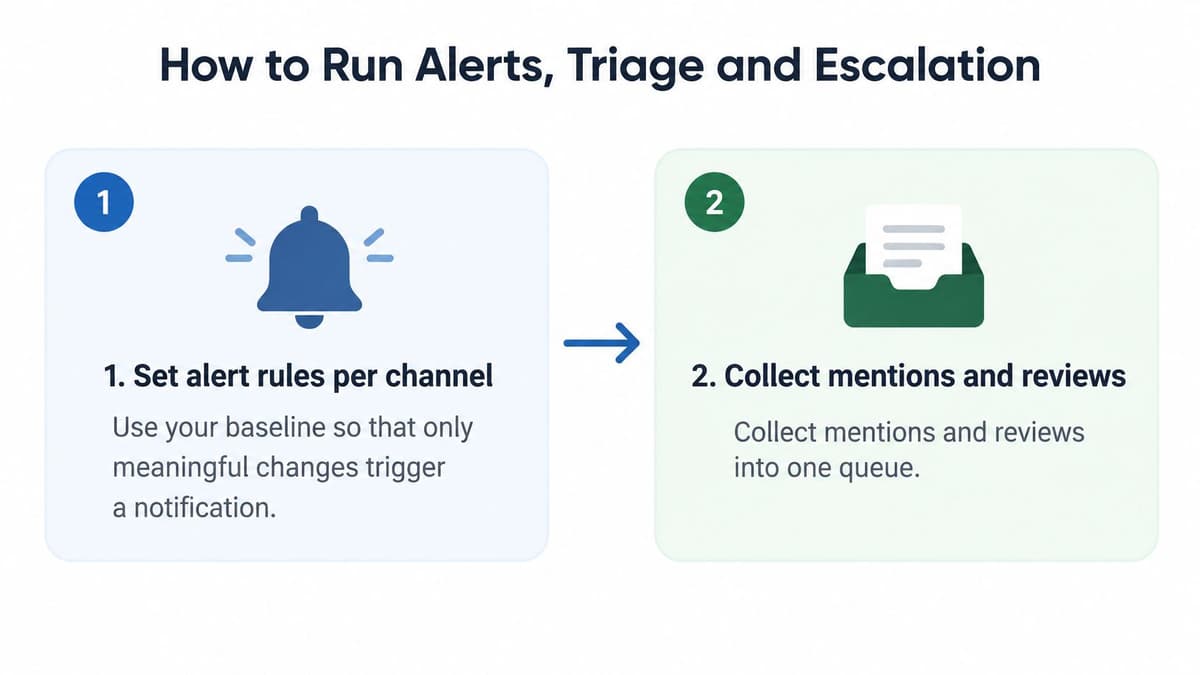
- Set alert rules per channel. Use your baseline so that only meaningful changes trigger a notification. Rules exist to prevent alarm fatigue.
- Collect mentions and reviews into one queue and remove duplicates. One queue stops the same complaint being handled three times, or not at all.
- Triage each item by severity and authenticity. Apply the checks from the fake-review routine first. Triage stops the team treating manipulated text as a real service failure.
- Assign one owner and draft a reply inside the target window. A named owner means the item does not wait for someone to notice it.
- Respond publicly with a short, factual reply, and move personal details to a private channel. Public facts build trust. Personal data does not belong in the thread.
- Escalate using the severity table, adding legal or leadership input where needed. Escalation is a decision, not a panic forward.
- Log the outcome and feed it into the monthly report. The log turns single incidents into a pattern you can see next month.
Targets below are starting points. Adjust them for team size and time zones. A three-person UK team cannot realistically promise a global overnight reply.
| Level | Example | Owner | Suggested first response |
|---|---|---|---|
| 1. Routine | A single question or compliment | Community or support team | Within one working day |
| 2. Recurring | The same complaint from several customers within a week | Customer lead with the product owner | Within one working day, with a public reply |
| 3. Spreading | A viral post, press pick-up or rating drop across platforms | Brand or communications lead with leadership | Within a few hours, using an agreed holding statement |
| 4. Legal or safety | An allegation of harm, a defamation claim or a regulator complaint | Legal counsel and leadership | Immediately; preserve evidence and avoid public speculation |
| 5. Coordinated | A sudden review surge with similar wording and unusual timing | Trust and safety owner | Preserve evidence and report to the platform the same day |
Practical rule: If you cannot name the owner in the same minute you open the alert, the workflow is not finished.
Level 3 needs a holding statement written in advance, not composed in the comments. Level 4 is about evidence and restraint. Level 5 borrows the authenticity checklist. Do not argue with a cluster in public while you are still collecting screenshots.
Best Practices and Governance Habits
Five habits keep the system useful after the first enthusiastic month.
- Set the baseline before you change anything. A campaign, a review request or a price move needs a reference point, or later movement is impossible to read.
- Name one owner per channel, plus a backup. Alerts that wait for "the team" wait too long.
- Review the rules each quarter. Drop noisy triggers that train people to ignore the inbox, and add channels that have become material.
- Answer genuine complaints in the same shape every time. Acknowledge the issue, state the facts, offer a private route for personal details, and follow up in public once it is resolved.
- Do not buy a clean profile, and do not accuse in public. Never ask for reviews in a way that rewards positive wording or hides negative feedback. Never reply to a suspected fake with an accusation. That harms trust and can breach platform rules.
Track a short list, not the full table, week to week. Flagged authenticity rate, median first-response time, the one- and two-star share trend, and the share of issues closed at level 2 or below. Revisit the targets each quarter. A team of three in one time zone needs different windows from a global brand, and pretending otherwise only produces missed alerts.
Choose Monitoring Tools That Fit Your Workflow
No single category of software does this whole job. Most social media schedulers are built for publishing, approvals and analytics. Reputation work also needs alerts across review sites and search, plus a log of what you replied. Buying a scheduler and calling it a monitoring stack leaves the review sites dark.
Judge any tool against a short list, and verify the monitoring claims with the vendor rather than a feature grid from last year.
Coverage. Does it watch the channels you chose, including reviews, not just your own profiles?
Alerts and tags. Can you set a baseline alert and tag product, delivery, price and service?
Access. Can more than one person see the queue, with an approval step where replies are sensitive?
Export. Can you pull the numbers for the one-page monthly report without a screenshot?
Price. Structures change. Check the vendor's site before you decide, and do not treat a quoted figure as permanent.
Tools worth comparing on those terms include Buffer, Hootsuite, Sprout Social, Metricool, Later, SocialBee, Publer, Vista Social, Planable, Postiz and Typefully. Some fit analytics-heavy teams. Others fit agencies or approval-heavy workflows. None of them should be assumed to score fake-review risk unless the vendor shows that workflow. Heavier listening platforms such as Brandwatch sit in a different category again, aimed at research teams who need history and scale, and you can read an independent profile on the Brandwatch scheduler listing before you book a demo. Pair a publisher with a listening or review tool when one login cannot see both the calendar and the complaint.
Scheduler.social is an independent directory that reviews and compares social media scheduling tools, which helps when reputation alerts and publishing need to sit in the same week without pretending one app does both jobs. You can compare options side by side and match coverage, approvals and analytics to the channels you already monitor. Visit Scheduler.social and find the scheduler that fits your team.