89% of UK adult internet users use social media, rising to 97% among people aged 16 to 34. For companies, effective social media management means building a structured operating system for planning, adapting, approving, publishing and measuring content across the channels where customers already spend time.
That reach changes the job. Social is no longer a side task handed to whoever has access to the company account. It sits between brand, customer service, sales, public relations and paid media, so a missed approval or poorly adapted post can affect more than the day's content queue.
A company can publish frequently and still operate badly. The difference comes from ownership, workflow design and the discipline to treat each platform as its own environment rather than another slot in a distribution checklist.
Table of Contents
- Why Social Media Management Matters Now
- What Social Media Management Actually Is
- Building Your Social Media Team Structure
- Strategic Planning Foundations
- Measuring What Actually Matters
- Common Challenges and How to Solve Them
- Tools and AI for Scaling Social Operations
- Your Next Steps for Social Excellence
Why Social Media Management Matters Now
UK businesses have been using social media as a business channel for longer than many current workflows suggest. In 2015, 35.0% of all UK businesses used social media, compared with 32.0% in the previous year. Among businesses using social media, 70% used it to develop their image or market products, according to the UK social media statistics analysis based on ONS data.
The implication is practical. Social media moved from experimentation into routine marketing activity, and routine activity needs ownership, calendars, review stages and reporting. A founder can post when inspiration strikes. A company with several products, audiences and approvers can't rely on inspiration.
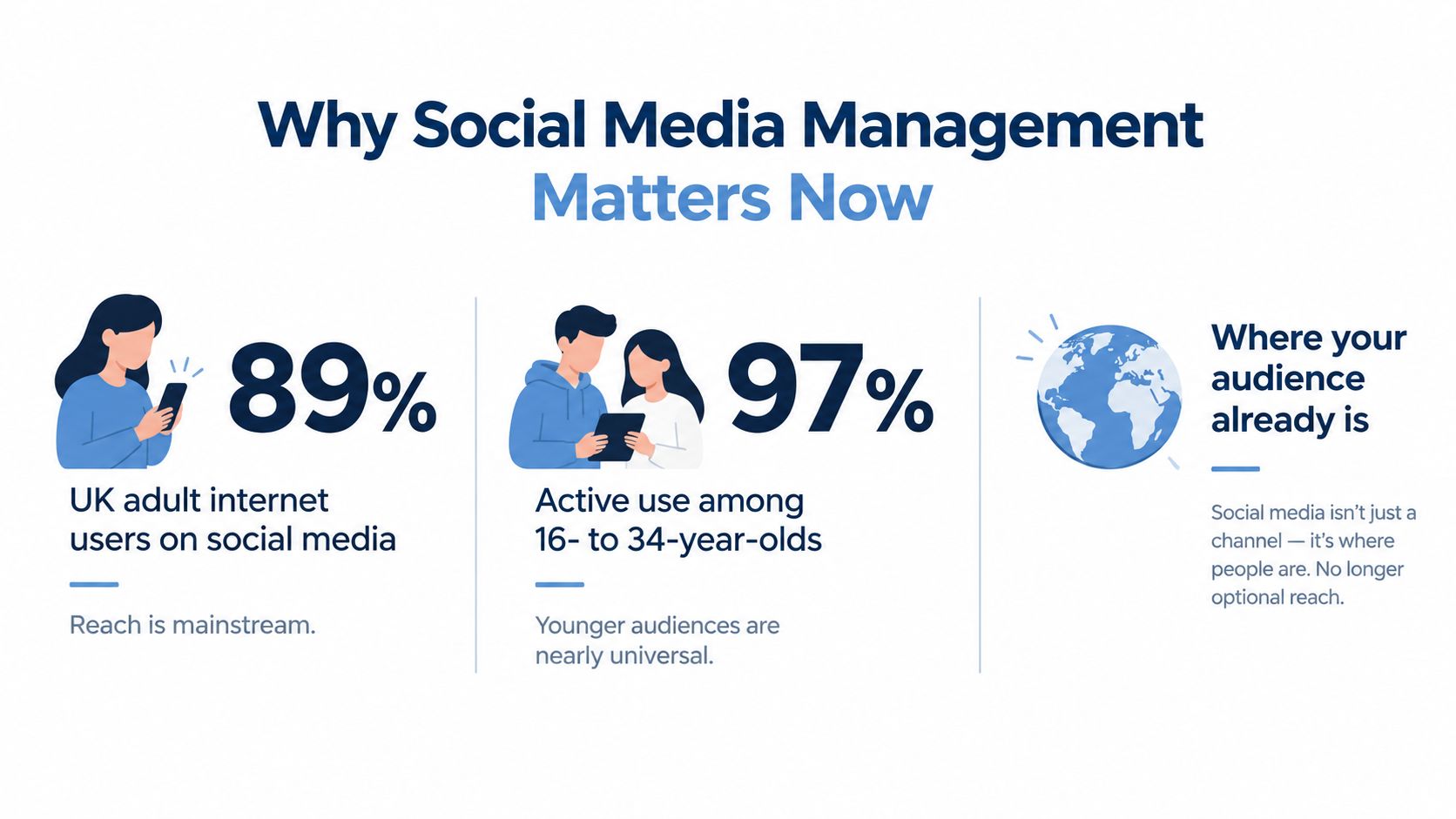
The scale of the audience makes casual execution harder to defend. 89% of UK adult internet users use social media, rising to 97% among people aged 16 to 34, as reported in UK social media agency market data. These figures don't tell a marketing director which post to publish, but they do establish that social is mainstream reach, not an optional experiment.
The operational shift
A small business might have one person writing posts, answering comments and checking performance. A larger company may have a copywriter, designer, product marketer, legal reviewer, agency partner and channel owner involved in the same campaign. Without a defined route between those people, the content either gets delayed or published without the right checks.
Paid investment raises the stakes further. UK social media advertising spend was reported at £11.5 billion in 2025, up 21% year on year and equal to 28% of the UK digital advertising market, according to UK social media advertising research. Companies don't need to treat every organic post like an advert, but they do need to understand that social now carries serious budget and reputation responsibility.
Practical rule: If a channel affects brand perception, customer conversations or campaign spend, manage it as an operating process, not as an informal publishing habit.
What Social Media Management Actually Is
Social media management is the system that turns a business idea into an appropriate, approved and measurable presence on each platform. Scheduling is one part of it. The full process also includes audience research, briefing, writing, design, adaptation, community response, risk checks, publishing and performance review.
A useful comparison is a production line. The content calendar acts as the production schedule, the brief defines the required output, and approval checkpoints function as quality control. Platform adaptation is the packaging stage. The same campaign may contain one idea, but the finished versions need different lengths, openings, visual treatments and calls to action.

From one idea to several usable assets
Suppose a software company wants to promote a new reporting feature. Basic management might copy the announcement into LinkedIn, Facebook and X. Strategic management starts with the same product truth, then changes the execution:
- LinkedIn: A concise business problem, supported by a customer or operational benefit.
- X: A sharper observation, thread or conversation prompt that fits a faster-moving feed.
- Instagram: A visual explanation, carousel or short demonstration.
- YouTube: A fuller walkthrough that can answer questions and support discovery.
- Facebook: A community-oriented explanation with context for existing customers.
The brand voice should remain recognisable, but identical wording isn't consistency. It can be a sign that the team skipped adaptation.
The minimum viable workflow
A dependable workflow gives every asset five things:
- An owner who is responsible for moving the work forward.
- A business purpose such as awareness, education, demand generation or customer support.
- A channel treatment that explains how the idea changes by platform.
- An approval route with named reviewers and a clear deadline.
- A measurement plan that defines what the team will assess after publication.
For a small team, one person may hold several roles. That isn't a problem if the roles are visible. It becomes a problem when nobody knows whether a post is waiting for legal approval, design changes or a final publishing decision.
Building Your Social Media Team Structure
The right team structure depends less on company size than on content volume, platform complexity and approval risk. A specialist financial services firm may need tighter review controls than a larger consumer brand with a simple product range. Start with the work that must happen, then decide who should own it.
| Structure | Best For | Key Roles | Pros | Cons |
|---|---|---|---|---|
| Solo operator | A founder-led brand or focused small business | Planner, writer, publisher, community owner | Fast decisions, low coordination overhead | Limited capacity, weak cover during absence, high dependence on one person |
| Small internal team | A growing company with several audiences or campaigns | Social lead, content creator, designer, reviewer | Better specialisation and stronger brand knowledge | Handoffs can slow work if ownership isn't explicit |
| Hybrid team | Companies needing internal direction with flexible production capacity | Internal strategist, agency specialists, approvers, channel owners | Access to broader skills without hiring every role | Requires stronger briefs, feedback discipline and account governance |
The solo model works when the company has a narrow offer and a manageable publishing rhythm. The operator can plan a campaign in the morning, create assets in the afternoon and publish without waiting for multiple stakeholders. The trade-off is resilience. If that person also handles customer replies and reporting, strategic work gets pushed aside whenever urgent requests arrive.
Where small teams get stuck
Small internal teams benefit from separating editorial ownership from subject-matter approval. The social lead should control the calendar and final channel treatment. A product or legal specialist should verify accuracy within a defined window, rather than rewrite the entire post from scratch.
Use role-based permissions when multiple people access company accounts. A practical explanation of how those permissions work is available in this guide to role-based access for social teams. The objective isn't bureaucracy. It's making it clear who can draft, approve, publish and manage access when responsibilities change.
When a hybrid model earns its keep
Outsourcing makes sense when specialist production is irregular, the company needs creative breadth or an internal team lacks platform expertise. It doesn't remove the need for internal ownership. Someone inside the company still needs to set priorities, protect the brand voice, approve sensitive claims and decide which results matter.
A good agency relationship adds capacity. It shouldn't require the client to rediscover the brief every week.
Before hiring, map the bottleneck. If ideas are plentiful but reviews are slow, hire or assign an approver. If approvals are quick but content quality is weak, add creative skill. If the team publishes well but can't explain business impact, strengthen analytics and reporting before adding more output.
Strategic Planning Foundations
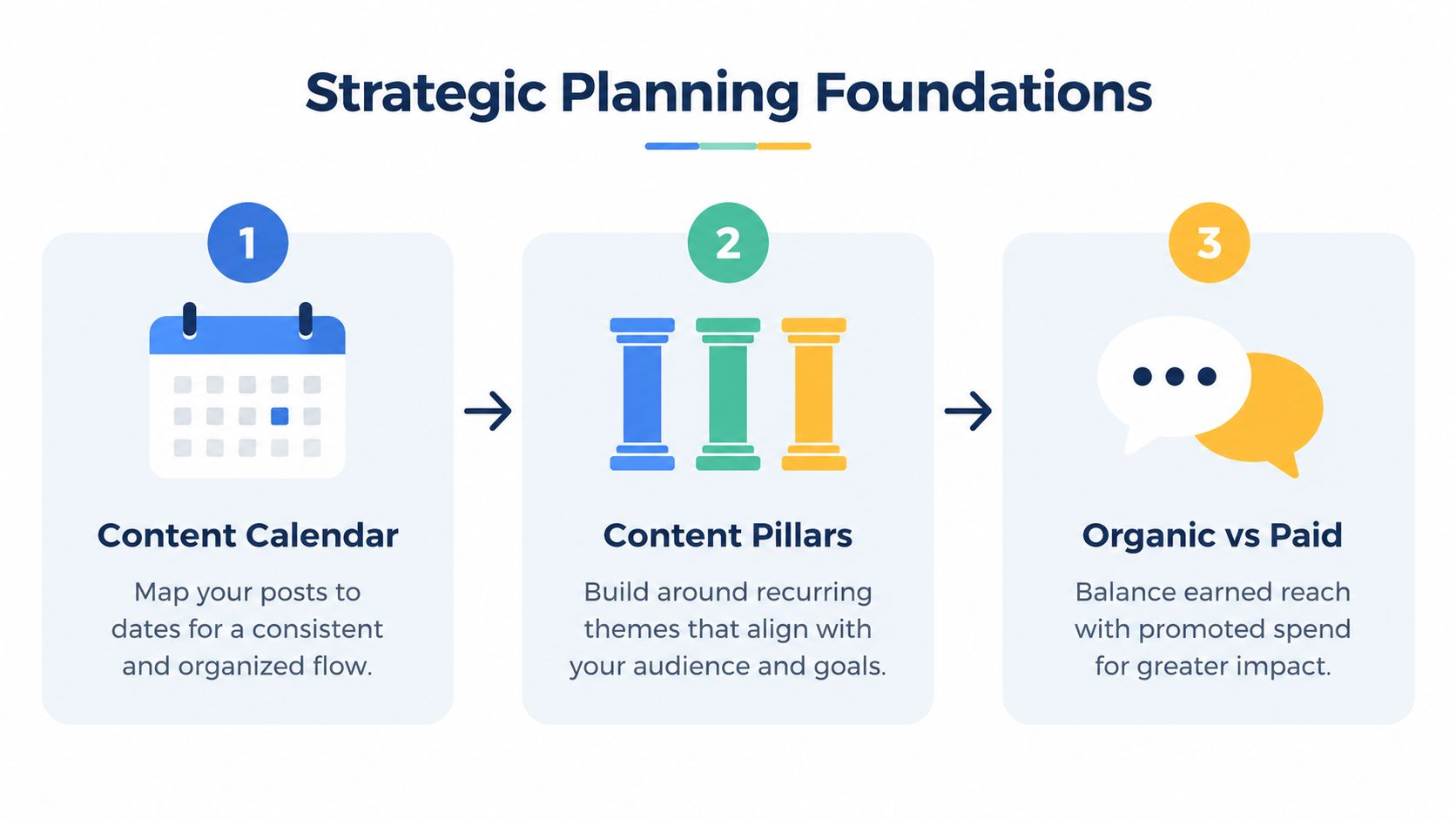
Strong planning connects three decisions: what the company needs to say, where each message belongs and whether distribution should be organic, paid or both. A calendar without strategy becomes a list of dates. Content pillars without a calendar remain abstract themes. Paid media without an organic learning loop can amplify a weak message.
Start with business moments
Build the calendar around events that matter to the company, not only around a desired posting rhythm. Include product launches, recruitment windows, customer deadlines, industry events, seasonal demand and planned campaigns. Then leave room for reactive content, because a calendar that has no capacity for live opportunities will be ignored as soon as reality intervenes.
A useful calendar entry contains more than a caption. Include the objective, audience, platform, asset format, owner, reviewer, approval deadline, publishing date and follow-up action. That information lets a manager see whether a campaign is ready or merely looks busy.
For a deeper operational approach, these best practices for 2026 social media provide useful planning context. Treat external frameworks as prompts, then adapt them to your approval capacity and commercial priorities.
Build pillars that can carry a quarter
Most companies need a small set of recurring themes rather than an endless stream of disconnected ideas. Three to five pillars are usually enough as a planning starting point, provided each one connects to a real business objective.
A B2B consultancy might use:
- Useful expertise: Explain a difficult issue in language buyers can use.
- Proof and perspective: Show how the team thinks, works or solves problems.
- People and culture: Make the organisation more recognisable and credible.
- Commercial relevance: Connect services to situations where buyers need help.
The pillars should guide choices, not force every post into a rigid template. If a customer question reveals a useful objection, it may belong to expertise and commercial relevance at the same time.
Organic and paid should inform each other
Organic content helps the team learn which ideas attract meaningful attention and conversation. Paid distribution can put a selected message in front of a defined audience or support a campaign that needs predictable reach. Neither replaces the other.
A disciplined process starts with the objective. Use organic publishing to develop credibility and learn from audience response. Use paid activity when the company needs targeted distribution, campaign scale or a clearer path to a commercial action. Document what paid promotion changes, rather than treating every result as evidence that the creative worked on its own.
Teams can use a dedicated content planning workflow to connect pillars, calendar entries and approvals before distribution decisions are made.
Measuring What Actually Matters
A report becomes useful when it changes what the team does next. A high impression count may confirm distribution, but it doesn't explain whether the right audience noticed the message, understood it, clicked through or moved closer to a purchase.
UK benchmarks show why platform-specific interpretation matters. A 2026 UK benchmarking summary reported Facebook reach up 51% and LinkedIn impressions up 23%, while Instagram Reels reach fell 35%, X link clicks fell 28% and TikTok views per video fell 17%, as summarised in UK SME social media channel research. These movements don't produce a universal verdict on any platform. They show that teams need separate success criteria for reach, attention, clicks and video consumption.
Choose the metric before the post
Match the indicator to the job:
- Reach: Useful when the objective is exposure, but insufficient for judging consideration.
- Engagement depth: Replies, saves, shares and meaningful comments reveal more than a passive reaction.
- Click-through rate: Helps assess whether the message and call to action create enough interest to visit a destination.
- Qualified leads: Connect social activity to people who meet the company's commercial criteria.
- Conversion attribution: Shows whether social contributed to an enquiry, purchase or other defined action, while recognising that buyers may use several channels before converting.
- Share of voice: Helps the team understand how visible the brand is within relevant conversations, provided the comparison set is consistent.
A weekly operational review should ask whether content was published on time, which approvals caused delay, whether community responses were handled and whether any channel needs immediate adaptation. A monthly strategic review should examine audience quality, channel contribution, creative themes and the relationship between organic learning and paid activity.
Reporting principle: Every metric in a stakeholder report should answer, “What decision will this inform?”
Avoid comparing a reach objective with a click objective as if they were the same contest. A post can perform its awareness role without generating traffic, while a specialist product explanation may attract fewer people but produce stronger commercial signals. The report should make that distinction visible.
Common Challenges and How to Solve Them
Most social teams don't fail because they lack ideas. They fail because the workflow can't absorb the ideas they already have. Approval delays, platform fatigue and unclear measurement create friction that appears as inconsistent publishing.
The approval bottleneck
Start by identifying where work stops. Does legal review every caption, or only regulated claims? Does a senior executive approve every post, or only announcements? Does the designer receive a complete brief, or a collection of messages across email and chat?
Set approval classes. Routine educational content may need an editorial review. Product claims may need subject-matter verification. Sensitive announcements may require senior or legal approval. Give each class a defined owner and deadline, then record status in one place.
Too many channels, too little adaptation
A company can be present on every major network and still serve none of them properly. If the team copies one post everywhere, the workload looks efficient but the audience experience becomes generic. If the team creates fully original campaigns for every channel, production can overwhelm the available people.
Use a core-and-variant model. Develop one central idea, then create a small number of deliberate versions based on audience behaviour, format and platform purpose. Pause channels that consume disproportionate effort without producing useful learning or business value.
The short-form video assumption also needs scrutiny. The UK benchmark pattern above shows that reach, clicks and views can move in different directions by platform and content type. A better response is adaptive workflow design, not automatic platform-hopping.
Resource and measurement gaps
Ask whether the team is spending its time on production, approvals, community management or analysis. If publishing consumes all available capacity, reduce unnecessary variants before hiring more people. If the team has time but no clear commercial signal, fix the measurement model first.
Track audience sentiment and question themes alongside posting activity. A rise in publishing volume doesn't compensate for unanswered concerns, repeated customer objections or declining relevance. Social management works when the team uses those signals to change the next brief.
Tools and AI for Scaling Social Operations
Tools should remove coordination waste, not hide poor decisions. A scheduling platform is useful when it gives the team one view of the calendar, clear ownership, approval status and channel-specific publishing options. It becomes less useful when it encourages the team to duplicate the same message without review.
Build the stack around the workflow
A practical evaluation starts with four questions:
- Can the team plan campaigns in a shared calendar?
- Can writers, designers, reviewers and publishers work from the same asset?
- Can the system adapt content for different channel formats?
- Can managers see what was approved, published and measured?
Scheduler.social is one example of this model. It combines a visual content calendar with AI-assisted writing, content adaptation, multi-seat collaboration, role-based review and publishing across channels including Twitter/X, Instagram, LinkedIn, Facebook, YouTube, Pinterest and Bluesky. Its Agentic Marketing Teams feature is in beta and is intended to coordinate campaign work with AI teammates, so teams should assess it against their governance requirements rather than assume that automation removes human judgement.
For teams that need help with writing engaging captions fast, AI can accelerate first drafts and variations. The editor still needs to check accuracy, tone, audience fit and platform conventions. Fast text that needs extensive correction isn't a productivity gain.
Use AI where judgement isn't required
AI is well suited to repetitive preparation:
- Repurposing: Turn a campaign brief into platform-specific draft versions.
- Variation: Produce alternative hooks, calls to action or opening lines for review.
- Organisation: Classify assets, suggest calendar placements and surface missing information.
- Quality checks: Flag inconsistent terminology, incomplete briefs or possible approval issues.
- First-pass reporting: Group posts by theme and identify patterns for a human to investigate.
Keep people responsible for claims, sensitive subjects, customer responses, crisis decisions and final brand judgement. A useful system makes the human checkpoint explicit instead of presenting generated content as finished work.
Teams comparing platforms can use this overview of social media management tools to define requirements before booking demonstrations. A small business may prioritise simplicity and reliable scheduling. An agency may need client separation, permissions and repeatable handoffs. An enterprise team may prioritise governance, auditability and integrations.
Your Next Steps for Social Excellence
Improvement starts with a workflow audit, not a new content theme. Select a recent campaign and trace it from the first idea to the final report. Record who wrote the brief, where assets were stored, who approved each stage, how many versions were created and which decision the results informed.
Then classify the main weakness:
| Primary bottleneck | First investment | What to change |
|---|---|---|
| Too much work depends on one person | Team capacity | Assign backup owners and separate planning, production and publishing responsibilities |
| Posts wait for unclear approvals | Process design | Create approval classes, named reviewers and deadlines |
| Content is copied across channels | Editorial capability | Add platform treatments and require a channel rationale in each brief |
| The team publishes but can't explain results | Measurement | Link each content type to an objective and decision metric |
| Work is scattered across tools | Technology | Consolidate calendars, assets, status and publishing where practical |
Don't attempt a complete transformation at once. Start with one campaign, one shared calendar and one approval route. Document what slows the work, then adjust the system before adding more channels or content volume.
A practical implementation sequence
First, establish ownership. Name the person accountable for the calendar and the person authorised to approve routine content. Subject specialists can review claims without becoming de facto editors of every post.
Next, create the pillar system. Choose themes that support commercial and audience needs, then build a small backlog of ideas under each theme. This gives the team enough direction to plan without turning the calendar into a rigid script.
Then, introduce channel variants. Require every campaign brief to state what changes for each selected platform. The change may involve format, opening, length, visual treatment or call to action. If nothing changes, record why.
Finally, set a review rhythm. Use operational reviews to fix workflow problems and strategic reviews to reallocate effort. Watch for progress in practical terms, such as fewer late approvals, clearer ownership, more useful audience responses and reports that lead to decisions.
Social media management for companies is never finished because audiences, platforms and business priorities keep changing. The advantage comes from building a system that can adapt without losing accountability. Treat the operation as a capability the company owns, not a maintenance task that disappears after publishing.
Scheduler.social gives teams a shared calendar, AI-assisted content adaptation, approval workflows and multi-channel publishing from one workspace. Visit Scheduler.social to organise your social operation around consistent planning, clear review and channel-specific execution.