How to Use AI in Marketing: A Practical Playbook for 2026
Learn how to use AI in marketing with our step-by-step playbook. Move from one-off tasks to a scalable system for content, ads, and analytics.
Many teams are in the same place right now. You've tried AI for a few headlines, a rough draft, maybe a batch of social captions, and it worked just well enough to be interesting. It also created a new problem. Content appears faster, but review gets messy, brand voice drifts, and nobody is fully sure which tasks should stay manual.
That's why learning how to use AI in marketing isn't really about picking a chatbot. It's about building an operating system for the team. The practical value is already clear. Research cited by ActiveCampaign found that marketers save an average of 13 hours per week, reduce operational costs by an average of $4,739 per month, and report better work quality and productivity when AI is used in day-to-day marketing workflows, as outlined in ActiveCampaign's AI marketing statistics roundup.
Table of Contents
- Moving Beyond AI Experiments to an AI Operating System
- Laying the Foundation for AI Success
- Choosing Your High-Impact AI Use Cases
- Building Your AI-Powered Marketing Workflow
- Mastering Prompts for Consistent Results
- Measuring ROI and Scaling Your AI Efforts
- Frequently Asked Questions on AI in Marketing
Moving Beyond AI Experiments to an AI Operating System
The failure mode is familiar. Someone on the team uses AI to draft copy. Someone else uses another tool for images. A third person pastes posts into a scheduler by hand. Output goes up for a week, then the process collapses under approvals, revisions, and inconsistency.
That's not an AI problem. It's an operating model problem.
UK-focused guidance makes that clear. Adoption is no longer the hard part. The gap is governance, repeatability, and safe operational use. One summary of UK adoption notes that 61% of businesses reported using some form of AI in 2025, but the bigger challenge is how teams automate the right workflows, control data use, and prove ROI without creating a compliance mess, as discussed in Park University's overview of AI in marketing.
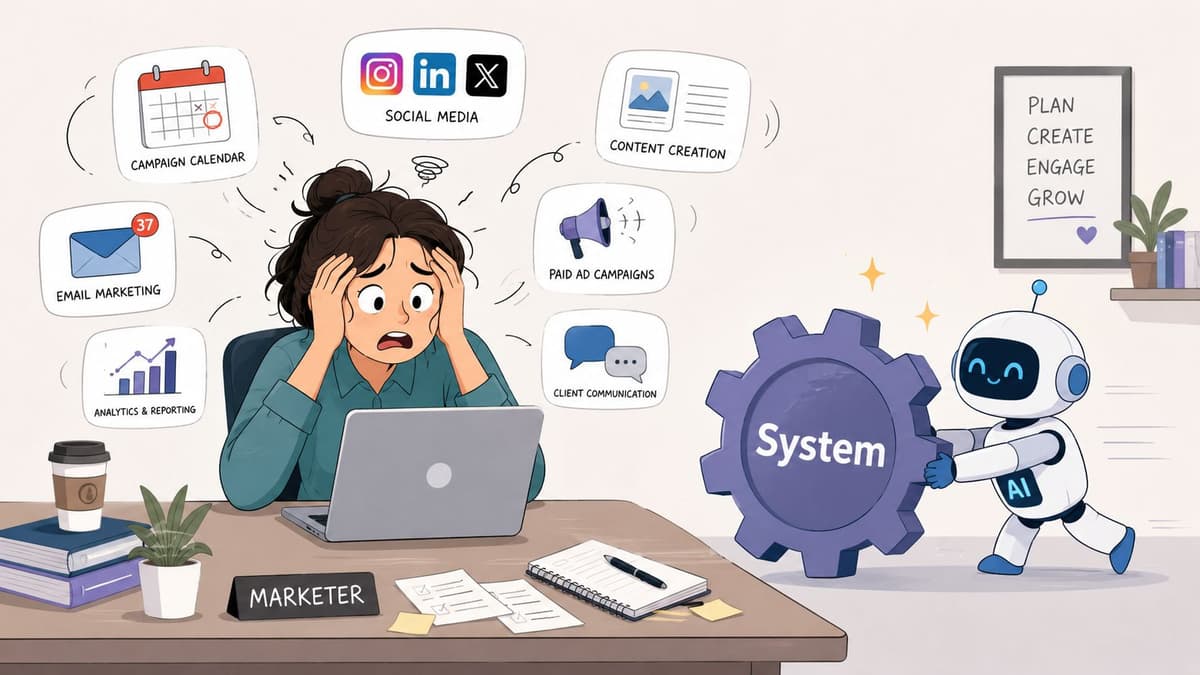
What works is simpler than people expect. We treat AI as a production layer inside the existing marketing system. It helps with draft creation, channel adaptation, reporting support, and repetitive execution. Humans still own positioning, approval, legal judgement, and final editorial control.
Practical rule: If AI speeds up a task but creates more review chaos downstream, the workflow isn't ready.
A lot of social teams are already moving in this direction because manual publishing is where good strategies go to die. Ideas don't fail because they're weak. They fail because they sit in docs, Slack threads, and half-finished drafts. If your team is also reworking its publishing process around current social media trends, AI only becomes useful when it plugs directly into that real workflow.
The shift is from scattered use to designed use. We don't ask, “Can AI write this?” We ask better questions:
- Which step is slowest: Ideation, drafting, adaptation, approval, or reporting.
- Which step is repetitive: The tasks your team handles the same way every week.
- Which step is measurable: The part of the process where you can see faster turnaround, more consistency, or better engagement quality.
That's the difference between experimentation and an AI operating system. One gives you novelty. The other gives you capacity.
Laying the Foundation for AI Success
Teams usually want to start with prompts. The better starting point is infrastructure. If the goals are vague and the data is messy, AI just scales confusion.
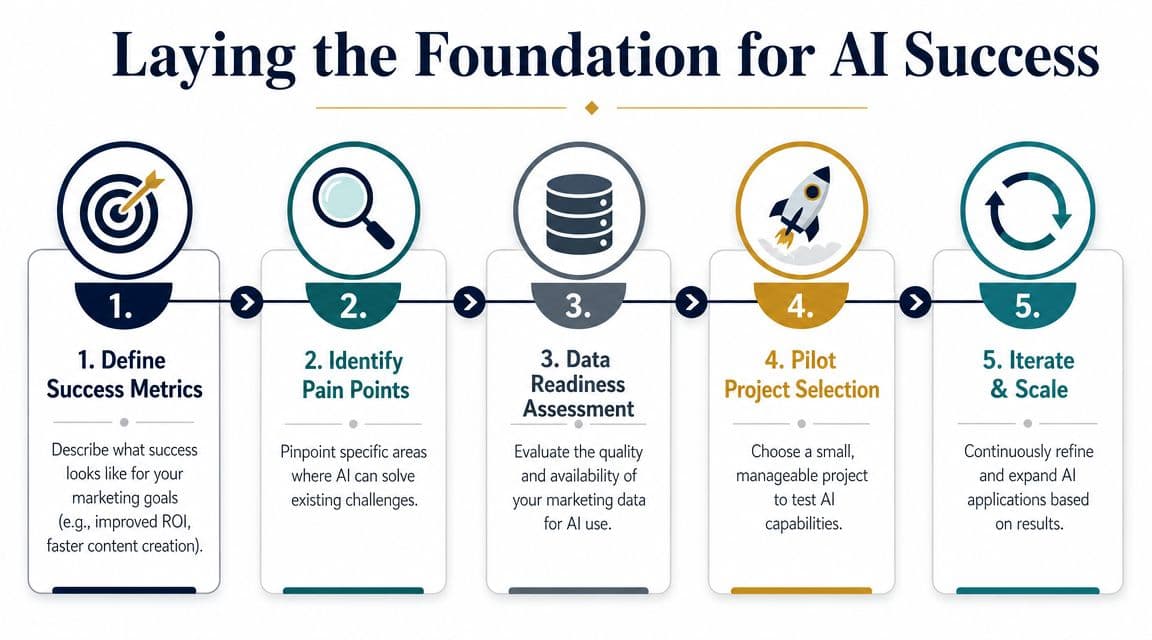
Start with business friction, not prompts
Pick one problem that's already costing the team time or consistency. Good candidates are slow content production, poor handoff between strategy and publishing, weak segmentation, or inconsistent campaign reporting.
Then define success in operational terms. For example:
- Approval speed: How long it takes a post or asset to move from draft to approved.
- Production consistency: Whether the team can hit its publishing cadence without last-minute scrambling.
- Channel adaptation quality: Whether one campaign idea becomes useful variations for LinkedIn, Instagram, X, Facebook, or email.
- Commercial movement: Whether engagement, conversion rate, or lead quality improves enough to justify the workflow.
A strong implementation starts with narrow scope. The guidance is direct. A strong UK marketing-AI implementation should start with data unification and quality controls: AI models perform best when CRM, web analytics, and sales data are standardized and integrated into one source of truth, then evaluated against clear KPIs before deployment, according to Improvado's guide to AI marketing analytics.
Create one source of truth before automation
This is a step often skipped because it isn't exciting. It's also the step that decides whether AI will help or mislead.
If CRM data uses inconsistent naming, campaign tags are sloppy, and web analytics don't align with sales outcomes, the model won't understand what success looks like. It can still generate words. It just can't support useful decisions.
Use a short data-readiness audit before any rollout:
- Check source systems: Review CRM, web analytics, ad platform data, email data, and sales outcomes.
- Fix naming conventions: Standardise campaign names, source labels, audience segments, and content categories.
- Remove noise: De-duplicate records, archive stale fields, and flag incomplete entries.
- Map KPIs to workflows: Tie each use case to a metric the team already cares about.
- Set review ownership: Decide who checks outputs, who approves publication, and who monitors results.
Bad data doesn't produce “slightly worse” AI. It produces confident nonsense.
The practical sequence is straightforward. Start with one use case such as segmentation or lead scoring. Clean the data behind it. Test outputs against a control or manual process. Retrain with fresh performance data if the signals are useful. If they aren't, stop there and fix inputs first.
A simple pre-launch checklist helps:
| Foundation check | What good looks like |
|---|---|
| Goal clarity | One business problem and one measurable outcome |
| Data quality | Standardised, current, relevant records |
| Team ownership | Clear reviewer and approver roles |
| Testing plan | A/B testing or side-by-side comparison |
| Go-live rule | No production use without KPI visibility |
Most AI disappointment starts long before the prompt box. It starts when teams automate on top of weak data and undefined success.
Choosing Your High-Impact AI Use Cases
Not every use case deserves attention first. Early wins usually come from areas where the work is repetitive, text-heavy, and easy to review. That's why content operations are often the cleanest place to start.
The UK pattern supports that. The Office for National Statistics reported that in 2024, 22% of UK businesses had used at least one AI technology, and among those firms the most common application was written language generation, cited in Teal's summary of the AI marketing specialist landscape. That matters because written language generation maps directly to campaign drafting, post variation, email copy support, and social scheduling workflows.
Where AI delivers value fastest
Four use cases usually stand out.
Content generation is often the entry point because it's easy to test. AI can draft blog outlines, paid social variants, caption options, and email copy. What works is using it for speed and first drafts. What doesn't work is publishing raw outputs without editorial control.
Audience personalisation becomes useful once your segmentation is reliable. AI can help classify intent, cluster audiences, and tailor message angles. This tends to outperform generic broadcasting, but only if your audience logic is already clean.
Advertising creative is strong when teams need multiple hooks, headline angles, and format variations quickly. AI helps widen the creative range. It doesn't replace strategic judgement on offer, audience, or brand risk.
Performance analytics is often underrated. AI can summarise reporting, identify patterns in campaign results, and surface anomalies faster than a manual spreadsheet pass. It's less flashy than copy generation, but often more valuable over time.
If you're comparing platforms before choosing a stack, Kelpi's list of AI marketing tools is a useful starting point because it groups tools by practical job rather than hype category.
AI Marketing Use Case Comparison
| Use Case | Potential Impact | Implementation Effort | Example Task |
|---|---|---|---|
| Content generation | Fast operational gain for lean teams | Low to medium | Draft a blog outline and create social captions from it |
| Audience personalisation | Better targeting and message fit | Medium | Build audience-specific message variants for returning vs new users |
| Advertising creative | More testing options across campaigns | Medium | Generate multiple paid social hooks from one offer |
| Performance analytics | Faster reporting and sharper optimisation | Medium to high | Summarise campaign performance and flag drop-offs by segment |
A practical prioritisation rule helps here:
- Start with content if the team is overloaded.
- Start with analytics if the team already ships enough content but can't learn fast enough.
- Start with personalisation if audience quality is the bottleneck.
- Start with ad creative if paid campaigns are active and variation is too slow.
The best first use case is the one your team can review quickly, measure clearly, and repeat every week.
That's usually why written content wins first. It has visible output, low technical friction, and a direct path into existing campaign operations.
Building Your AI-Powered Marketing Workflow
Most AI advice stops at generation. Real teams need a workflow that goes from idea to approved publication without adding another layer of manual mess.
Adobe's 2026 roundup cites industry figures showing 60% of marketers use AI tools daily and 67% of small and medium-sized businesses now use AI in marketing, which signals a move from isolated tests to routine execution in Adobe's AI marketing trends roundup.
A workable daily production flow
Here's a pattern that holds up under team pressure.
First, create one core asset. That might be a campaign angle, a blog draft, a product launch note, or a customer insight. Use AI to help brainstorm hooks, tighten structure, or produce a rough first version.
Second, adapt that core idea by channel. The copy shouldn't be identical everywhere. LinkedIn may need a more professional framing. Instagram needs a tighter caption and stronger visual cue. X may need a thread structure. YouTube community posts need a different rhythm again.
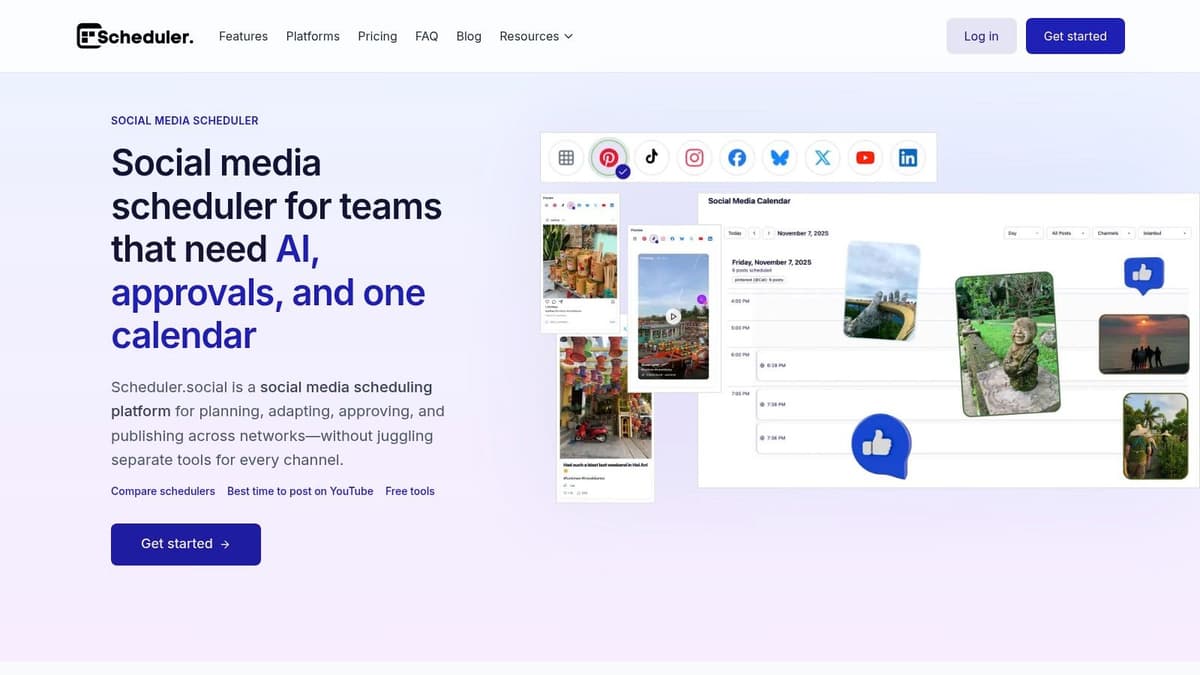
Third, move the drafts into a governed publishing workflow. Many teams often lose control in this stage if they rely on copying text between documents and tools. One option is Scheduler.social, which combines a visual content calendar, AI-assisted writing workflows, approvals, and cross-channel publishing in one place. If your team is also evaluating broader ideas around AI content creation workflows, the key distinction is whether the tool supports review and scheduling, not just generation.
A simple operating model looks like this:
- Ideate: Generate angles, hooks, and topic clusters.
- Draft: Build one strong source asset.
- Adapt: Produce channel-specific variants.
- Review: Check brand fit, claims, tone, links, and compliance.
- Schedule: Assign dates, formats, and owners.
- Analyse: Review engagement patterns and feed lessons back into prompts.
Where approval and scheduling matter
This is the point where AI shifts from clever helper to real system. Drafting is only one part of the job. Teams still need status tracking, ownership, approval order, and a clear calendar.
That's also why governance belongs inside the workflow, not in a separate policy document nobody reads.
Good AI marketing workflows have fewer copy-paste steps, fewer hidden drafts, and clearer approval points.
For teams thinking more broadly about automation maturity, AI for marketing success is useful reading because it frames AI as an execution system rather than a one-off content trick.
The review stage deserves explicit rules:
- Brand check: Does the language sound like us.
- Claim check: Are benefits described accurately and safely.
- Channel check: Does the format suit the platform.
- Compliance check: Are there privacy, legal, or sector-specific issues.
- Scheduling check: Is timing aligned with the campaign calendar.
Later in the process, video can support training and internal rollout. This walkthrough is a useful example of how publishing systems fit together in practice:
Once this workflow is stable, AI stops feeling like an extra app. It becomes part of how the team ships work every day.
Mastering Prompts for Consistent Results
Most weak AI output comes from weak instructions. Marketers often ask for “a post about X” and then complain that the result is generic. The model did exactly what it was told.
The prompt structure that reduces rewrites
A useful framework is role, task, context, format, constraints. It gives the model enough direction to produce something the team can edit and approve.
Use this structure:
- Role: Who the AI should act as.
- Task: What it needs to do.
- Context: Product, audience, campaign, tone, goal.
- Format: Bullets, table, thread, caption set, outline.
- Constraints: Word count, banned claims, brand rules, CTA style.
Here's a base template:
Act as a senior B2B marketing copywriter.
Your task is to create [asset type].
Context: [audience, product, offer, funnel stage, brand voice].
Format the output as [specific structure].
Constraints: [length, tone, prohibited phrases, factual limitations, CTA requirement].
That structure improves consistency because it removes ambiguity before the model starts writing.
Prompt templates marketers can actually reuse
For a pillar page outline
Act as a content strategist for a UK SaaS brand. Create a pillar page outline on how to use AI in marketing for small and mid-sized teams. Include an introduction, six main sections, FAQ ideas, and internal link opportunities. Keep the tone practical, not promotional.
For multi-channel social adaptation
Act as a social media manager. Turn the following blog summary into platform-specific variants for LinkedIn, Instagram, X, and Facebook. Keep the core message consistent, but adapt structure and tone for each channel. Add a short CTA to drive readers to the article. Do not repeat identical phrasing across platforms.
For email subject line ideation
Act as an email marketer. Generate 15 subject lines for a campaign about improving marketing workflow efficiency with AI. Audience: marketing managers at growing businesses. Tone: clear and credible. Avoid hype, fear tactics, and exaggerated claims.
For tone-of-voice analysis
Act as a brand editor. Review the sample copy below and describe the tone of voice using five traits. Then rewrite the weak sections so the tone feels more direct, confident, and concise without sounding aggressive.
A few habits make prompts better over time:
- Feed examples: Give the model one or two past assets that match your preferred style.
- Name the audience: “Small business owners” is weaker than “UK ecommerce marketing managers”.
- State what to avoid: Mention clichés, claims, formatting, or phrases that don't fit your brand.
- Ask for options: Request three angles or structures instead of one.
Specific prompts don't limit creativity. They stop the model wasting time on the wrong kind of creativity.
Once the team shares prompt patterns internally, output quality becomes far more predictable. That's when prompt writing stops being a personal trick and becomes team process.
Measuring ROI and Scaling Your AI Efforts
AI without measurement turns into a belief system. Someone feels faster. Someone else says quality slipped. Finance asks what changed. Nobody has a clean answer.
What to measure first
Go back to the KPI logic set at the start and track workflow movement before you chase broader strategic impact. The first indicators are usually operational:
- Time to publish: How long assets take to move from idea to scheduled post.
- Content throughput: Whether the team can maintain publishing cadence more reliably.
- Cost per asset: Whether production effort drops without creating hidden review costs.
- Approval turnaround: Whether bottlenecks are shrinking.
- Engagement and conversion signals: Whether the adapted content performs better than the old manual baseline.
Put the old manual process beside the new assisted workflow and compare like for like. If AI is helping, you should see clearer output consistency, faster turnaround, or stronger downstream performance. If none of those move, the process probably isn't mature enough yet.
How to scale without losing control
The mistake is scaling horizontally too soon. Don't roll AI into every marketing function after one promising week in social.
Scale in layers instead:
- Stabilise one workflow: Usually social content or reporting support.
- Document the rules: Prompt templates, approval steps, tone standards, escalation points.
- Train reviewers: Make sure editors, marketers, and approvers use the same quality bar.
- Expand to an adjacent use case: Email, ad creative, or segmentation often comes next.
- Review tooling gaps: If publishing is still fragmented, tighten the system before widening adoption.
For teams assessing the scheduling and governance side of the stack, this guide to social media automation tools is useful because it frames automation around control, not just speed.
The business case for AI gets stronger when the proof is operational, repeatable, and easy to explain. Faster output is nice. Reliable output with measurement behind it is what gets buy-in.
Frequently Asked Questions on AI in Marketing
Should we let AI publish content without human review
No. AI is useful for drafting, adaptation, and pattern spotting. Final review should stay with a person who can check brand voice, factual accuracy, compliance, and audience fit.
What's the best first AI project for a small marketing team
Start with a narrow workflow that is repetitive and easy to review. Social caption drafting, blog repurposing, or reporting summaries are usually safer first steps than fully automated personalisation or complex lead scoring.
How do we know whether AI is helping or just creating more work
Measure the workflow, not just the output. If the team publishes more consistently, spends less time on repetitive drafting, and maintains quality through review, the system is helping. If revisions pile up and approval slows down, the process needs redesign.
If your team wants a cleaner way to turn AI drafts into approved, cross-channel publishing, Scheduler.social gives you one place to plan content, adapt posts for different networks, manage approvals, and schedule publishing without bouncing between tools.