How Much Do Youtube Pay Per 1000 Views
Discover exactly how much do youtube pay per 1000 views in the UK for 2026. Learn about RPM vs CPM, factors affecting earnings, & how to boost your payout.

YouTube doesn't pay a fixed amount per view. For UK creators, a practical long-form RPM range is often around $1 to $10 per 1,000 views, though some standard video guidance stretches to $1 to $30 per 1,000 views depending on niche, audience geography, and ad demand.
If you're checking your analytics and trying to turn views into actual money, that's the point where most creators get misled. They search “how much do YouTube pay per 1000 views”, see one neat number, and assume every thousand views should earn roughly the same amount. That isn't how the platform works, especially if your audience is partly in the UK and partly elsewhere.
A UK creator can publish two videos with similar view counts and get very different payouts. One reason is that advertisers usually value Tier 1 audiences such as the UK more highly than lower-CPM regions, but your earnings still depend on what percentage of views were monetised, what topic the video covered, what ad formats ran, and whether the traffic came through long-form videos or Shorts. If you've been treating “1,000 views” as the whole story, you've been looking at the wrong metric.
Table of Contents
- The Real Answer to YouTube's Million-Pound Question
- Understanding CPM Versus RPM
- Key Factors That Influence Your YouTube Earnings
- A Practical YouTube Earnings Calculation
- Beyond Ads Other Ways To Earn On YouTube
- Actionable Tips To Increase Your YouTube RPM
- Conclusion Debunking Common YouTube Money Myths
The Real Answer to YouTube's Million-Pound Question
A new creator usually asks this right after monetisation starts. “I've got views coming in. What are those views worth?”
The honest answer is that YouTube doesn't really pay per view. It pays through monetised ad revenue, and the number creators should care about is RPM, not a mythical fixed price tag for each click. That matters even more in the UK, because articles often quote one global average while skipping the practical issue that your earnings depend heavily on where your audience is and how valuable advertisers consider that market.
Guidance aimed at creators notes that Tier 1 audiences, including the UK, typically attract higher CPMs, while broader averages still span roughly $2 to $12 per 1,000 views in general discussions of YouTube earnings (Talks creator pay explainer). That doesn't mean every UK creator gets “UK rates” automatically. If a lot of your traffic comes from outside the UK, your actual payout can still drop.
Why the simple answer misleads people
Most confusion comes from one bad question: “What does YouTube pay for 1,000 views?”
That question sounds sensible, but it bundles together several different things:
- Advertiser spend: What brands bid to reach your audience
- Monetised playbacks: Whether ads ran on those views
- Creator share: What lands in your account after YouTube's cut
- Traffic mix: Whether those views came from long-form videos or Shorts
Practical rule: Treat “per 1,000 views” as a rough shorthand, not a guarantee.
If you want a deeper breakdown of the format difference, this guide for creators on Shorts pay is useful because it separates the long-form model from the very different Shorts model. That split is where many new UK creators get caught out.
Understanding CPM Versus RPM
If you only learn two finance terms on YouTube, learn these: CPM and RPM.
CPM is what advertisers pay per 1,000 ad impressions. RPM is what you earn per 1,000 views after YouTube's share and after the messy realities of monetisation have done their work. That's why creators who stare at CPM alone often think they're earning more than they really are.
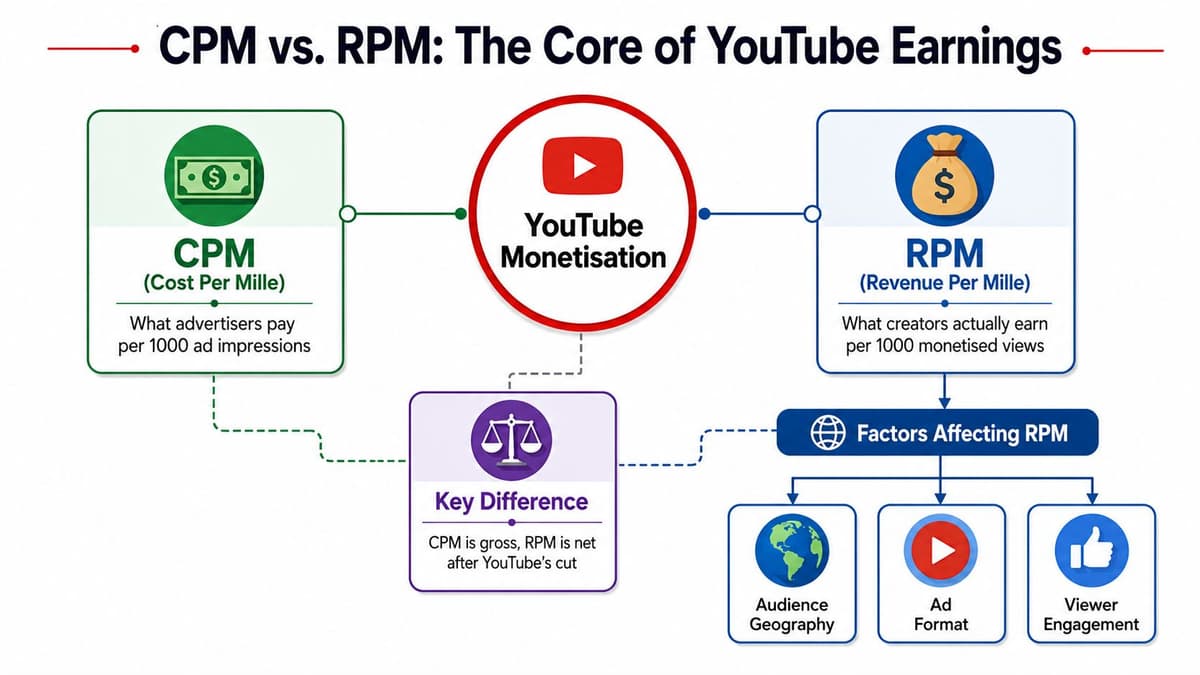
Think of it like a shop till
A simple analogy helps here.
CPM is like the sticker price on the shelf. It tells you what the item is listed for in the shop. RPM is what's left in the till for you after discounts, fees, and unsold stock are accounted for.
That's why RPM is the better number for answering “how much do YouTube pay per 1000 views”. It reflects reality.
In UK creator guidance, earnings are better described through RPM because YouTube only shares ad revenue from monetised views, and the creator keeps 55% of long-form ad revenue after YouTube's cut. The same guidance commonly places long-form RPM around $1 to $10 per 1,000 views for Tier 1 audiences (Check the Worth YouTube revenue guide).
Why your RPM is always lower than your CPM
Creators often see a strong CPM in analytics and expect a similar payout. Then the money arrives and feels smaller.
That happens because:
- Not every view becomes a monetised playback
- Not every viewer gets the same ad opportunity
- YouTube takes its platform share before you get paid
- Audience location changes advertiser demand
CPM tells you what the market paid for ad exposure. RPM tells you what your business actually kept.
That distinction is the centre of YouTube finance. Once you understand it, your analytics stop looking random.
Key Factors That Influence Your YouTube Earnings
Two channels can get the same number of views and earn very different amounts. The reason isn't luck. It's usually a mix of audience quality, content topic, viewing behaviour, and the ad market around that video.
Creator education sources put standard video earnings at roughly $1 to $30 per 1,000 views, and they also note that UK ad demand, audience geography, and niche mix can push the same 1,000 views toward the low end or much higher depending on the topic (Influencer Marketing Hub guide to YouTube earnings).
Audience geography matters more than most creators think
A UK-based creator doesn't automatically earn a UK-style RPM on every video. YouTube pays based on the audience advertisers are trying to reach, not the postcode of the creator.
If your viewers are mostly in the UK, that can help because UK audiences are generally considered more valuable than lower-CPM regions. If your views are scattered across many countries, your blended RPM may look very different from what you expected.
Here's the practical takeaway:
- Channel location isn't the key variable: Audience location matters more
- Mixed traffic changes payouts: A video watched globally won't behave like a UK-only video
- High-value markets help: UK audiences are often grouped with other Tier 1 markets
Niche changes the value of the same view count
Advertisers don't bid evenly across all topics. A broad entertainment video and a finance tutorial can both hit the same view count, but advertisers may value those viewers very differently.
That's why some niches tend to sit near the lower end of the range while others can move much higher. Topics tied to money, software, business tools, or high-intent purchases often attract stronger advertiser demand. Broad humour, general vlog content, and low-intent entertainment may not.
A creator doesn't control advertiser budgets, but they do control what kind of audience they build.
Format, watch time, and timing all shift earnings
Longer videos usually create more room for ad opportunities. Better retention often means viewers stay long enough to see more of the monetised experience. Seasonal advertiser demand can also change how much those views are worth.
A few practical levers matter most:
- Video format: Long-form generally has more ad flexibility than Shorts
- Watch time: If people leave quickly, there are fewer monetisation opportunities
- Ad suitability: Brand-safe videos usually give YouTube more room to serve ads
- Seasonality: Advertiser demand rises and falls through the year
- Traffic source quality: Some traffic mixes monetise more cleanly than others
One of the biggest mistakes I see is creators focusing only on thumbnails and titles while ignoring whether the content itself attracts an advertiser-friendly audience. Views matter, but valuable views matter more.
A Practical YouTube Earnings Calculation
Most creators understand the theory once they see the maths on one example. You don't need a complicated spreadsheet. You need a sensible estimate.
A simple way to estimate revenue
Start with RPM, because that's the cleanest way to think about earnings.
If a video earns at the lower end of a typical long-form RPM, 1,000 views produce a much smaller result than a video earning at the higher end. The formula is simple:
Estimated earnings = RPM × (total views ÷ 1,000)
You can also work backwards from the creator share idea. For long-form ad revenue, the creator keeps 55% after YouTube's cut, which is one reason RPM ends up lower than the CPM figure visible in some reports.
Don't use a single “YouTube pays this much” number for your whole channel. Use a working RPM range and update it as your audience mix changes.
Sample YouTube Ad Revenue Calculation
This is a simplified example using only verified figures and plain assumptions.
| Metric | Value | Calculation |
|---|---|---|
| Total video views | 100,000 | Starting point |
| Example RPM scenario A | $1 | Lower end estimate |
| Example RPM scenario B | $10 | Higher common long-form estimate |
| Estimated earnings at scenario A | $100 | $1 × (100,000 ÷ 1,000) |
| Estimated earnings at scenario B | $1,000 | $10 × (100,000 ÷ 1,000) |
| Example higher benchmark scenario | $30 | Upper end of broader standard-video guidance |
| Estimated earnings at higher benchmark | $3,000 | $30 × (100,000 ÷ 1,000) |
What this table shows is simple but important. The same 100,000 views can produce very different outcomes depending on the RPM attached to those views. That's why the search phrase “how much do YouTube pay per 1000 views” has no single honest answer.
If you're estimating your own channel, use your recent long-form videos, check where your audience is coming from, then build a conservative range rather than one optimistic guess.
Beyond Ads Other Ways To Earn On YouTube
Ad revenue matters, but it shouldn't be your whole plan. Mature channels usually stack income sources because ad RPM moves around, and creators need something more stable than hoping every upload lands in a good ad market.
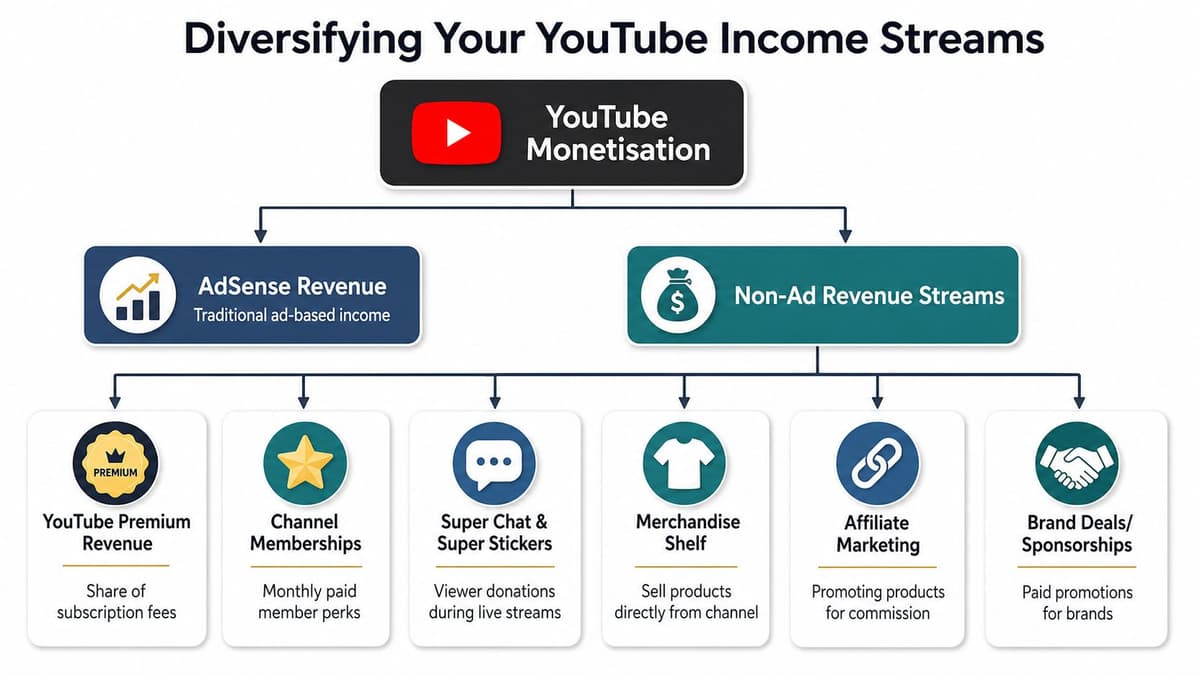
Income that comes from YouTube features
YouTube itself offers several ways to earn beyond standard ad placements.
- YouTube Premium revenue: If Premium subscribers watch your content, you can receive a share tied to their viewing.
- Channel Memberships: This works well when you can offer clear perks such as bonus videos, badges, or member-only posts.
- Super Chat, Super Stickers, and Super Thanks: These are strongest when you have a live audience or a loyal community willing to support directly.
- Shopping tools: Useful if your channel naturally connects to products, merch, or affiliate-style recommendations.
Live content can open up some of these features more effectively than standard uploads. If you're experimenting there, this guide on how to stream live to YouTube is a practical starting point.
Income that sits around your YouTube channel
Many creators make more predictable money outside the ad system than inside it.
That usually includes:
- Affiliate marketing: Best when your audience trusts your recommendations
- Brand deals: Works when your niche is clear and your viewers are valuable to a sponsor
- Merchandise: Good for community-led channels with a recognisable identity
- Services or products: Common for educators, coaches, consultants, and software-led creators
If you want a broader planning framework, this piece on 7 revenue streams for video creators is worth reading because it treats creator income as a system rather than one payout source.
A healthy YouTube business usually looks like a stool with several legs. Ads are one leg. If that's the only one you build, the whole thing feels unstable.
Actionable Tips To Increase Your YouTube RPM
You can't control the ad market, but you can shape the conditions around your channel. That's where RPM grows.
The biggest shift is mental. Stop asking only, “How do I get more views?” Start asking, “How do I attract better-fit viewers, hold them longer, and package the content in a way advertisers can use?”
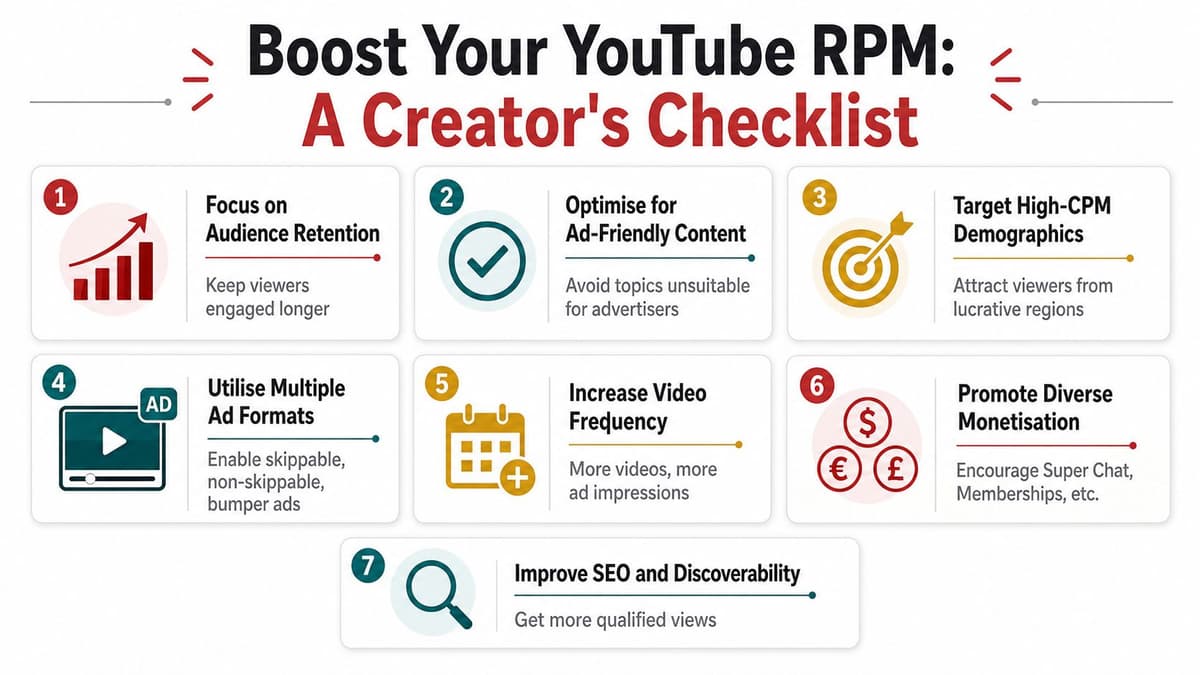
The moves that usually help most
- Choose commercially useful topics: If advertisers can clearly map your audience to a product category, the content is usually more valuable.
- Build for the right audience, not just a large one: A smaller UK-heavy audience in a strong niche can outperform a broader low-intent audience.
- Make long-form videos worth staying for: Better retention often supports better monetisation.
- Keep content advertiser-friendly: Some topics are harder to monetise cleanly, even when they get views.
- Plan around audience behaviour: Timing matters because distribution quality affects who sees the video first.
Upload timing is one of those details creators ignore until they realise early viewer response shapes the quality of a launch. If you want a practical reference, this guide on the best times to post on YouTube can help you test publishing windows more deliberately.
Here's a useful walkthrough to pair with that:
What to review before your next upload
Use this as a quick creator-manager checklist:
- Topic fit: Does this subject attract buyers or casual browsers?
- Audience fit: Is this likely to pull in viewers from markets you want?
- Retention plan: Is there a strong reason to keep watching after the opening?
- Format choice: Should this idea be a long-form video, or is it better as a Short used for discovery?
- Monetisation path: Besides ads, can this video support memberships, affiliates, or a later live session?
Manager's view: A channel grows faster when every upload has both a content goal and a revenue logic.
Conclusion Debunking Common YouTube Money Myths
Most myths about YouTube earnings come from oversimplifying a platform that doesn't work on a flat-rate model. If you remember one thing, remember this: focus on RPM, audience quality, and format, not raw view count alone.
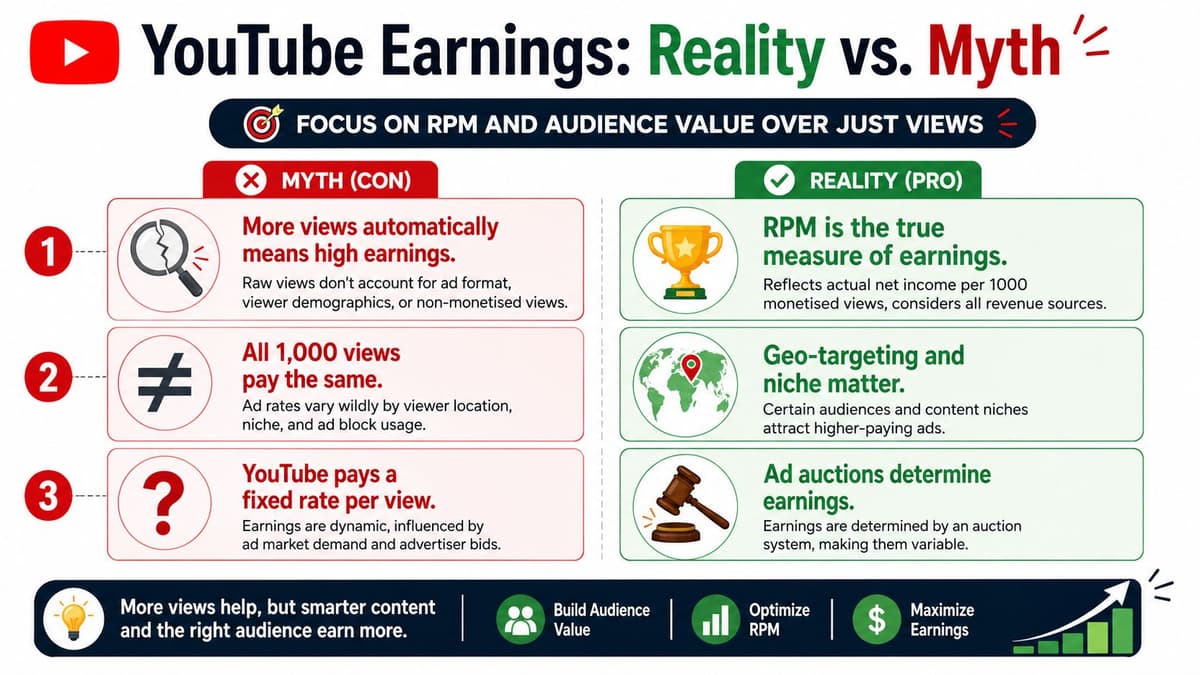
Three myths keep tripping creators up:
Myth one: YouTube pays a fixed amount per view.
Reality: earnings vary because ad auctions, audience geography, and monetisation mix change from video to video.Myth two: All 1,000 views are equal.
Reality: they aren't. A UK-heavy, advertiser-friendly audience can behave very differently from a broad global audience.Myth three: Shorts pay like long-form.
Reality: recent creator-focused coverage says long-form videos commonly land around $1 to $10+ RPM, while Shorts RPM is about $0.03 to $0.20 per 1,000 views, and Shorts uses a pooled revenue model rather than normal CPM (Graphy breakdown of YouTube pay).
That last point matters more than ever for UK creators. Shorts can be excellent for reach, discovery, and audience growth. They're often not the same thing as strong direct revenue. If live content is part of your strategy, having the right gear and workflow helps. This streaming setup for beginners is a useful place to start if you want a simple setup without overbuying.
If you compare platforms, it's also worth seeing how different monetisation models stack up. A TikTok money calculator guide gives a useful contrast to YouTube's RPM-led approach.
The creators who build reliable income don't obsess over one magic number. They build a channel that attracts the right viewers, in the right format, with more than one way to earn.
If you want to stay consistent enough to test what improves your YouTube results, Scheduler.social helps you plan, adapt, approve, and publish content from one place. You can map uploads on a visual calendar, organise multi-channel promotion without jumping between apps, and use AI-assisted workflows to turn one video idea into customized posts for YouTube, X, LinkedIn, Instagram, and more. It's built for creators, teams, and agencies that want less manual posting and a steadier publishing rhythm.